
A 3 MW generator is a 3,000 kW set, and at a 0.8 power factor it’s rated 3,750 kVA. It’s also the point where the high-speed engine family runs out. At 3 MW you’re buying the largest frame in a familiar platform, priced at the top of its curve, and heavy enough that the shipping plan starts shaping the specification.
Picture how most buyers meet that fact. The load calculation comes back at 2,900 kW, the budget was built on 2 MW pricing, and the first serious quotation arrives with a nine-month lead time and a 23-tonne shipping weight. Nothing about the number 3 MW prepared anyone for that.
You already know roughly what size you need. What this guide adds is the part no product page covers: what 3 MW does to current, to transport, to fuel logistics, and to the engine platform you’re buying from. We’ll go through the nameplate arithmetic, the physical envelope, the fuel case, and the items that belong on a 3 MW RFQ.
We build generator sets across the 8 kVA to 4,000 kVA range and quote megawatt-class projects case by case. If you have a load schedule and a site plan, send both to our engineers and you’ll get an answer based on your site rather than on a spec sheet.
Key Takeaways
- A 3 MW generator is 3,000 kW and 3,750 kVA at 0.8 PF. A set sold as “3,000 kVA” is only 2,400 kW.
- At 480 V a 3,750 kVA alternator delivers 4,511 A, enough to force paralleled cable runs or a step up to 4,160 V.
- A 3 MW diesel set can weigh 19 to 23 tonnes and stand 3.35 m high, taller than the inside of a 40-foot high-cube container.
- At full load it burns roughly 700 to 770 litres an hour, about one road tanker per day of running.
- 3 MW is the top of the high-speed engine family, so lead time and parts commonality matter more than the fuel curve.
What 3 MW Means on a Nameplate
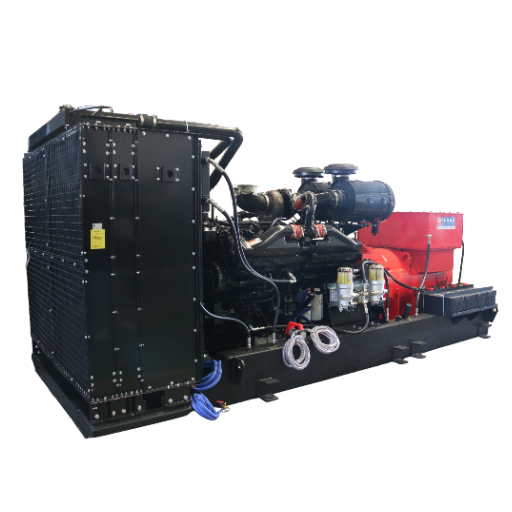
Three numbers describe the same machine, and they’re not interchangeable: 3,000 kW, 3,750 kVA, and on a gas set, 3,000 ekW. Mixing them up is the most expensive arithmetic mistake in this class, because 20% of a 3 MW project is 600 kW.
kW, kVA and Amps at 3 MW
A diesel set is normally quoted in kW for the engine and kVA for the alternator. The link is the power factor, usually 0.8 for industrial sets:
3,000 kW ÷ 0.8 = 3,750 kVA
Read that backwards and the trap appears. A seller offering “3,000 kVA” is offering 2,400 kW at the same power factor. That’s 600 kW short of a 3 MW requirement. Convert every quotation to kW before comparing it with another.
Current is the next number that changes decisions. For a three-phase set, current is 3,750,000 ÷ (√3 × voltage).
| Voltage | Rated current at 3,750 kVA | What it usually implies |
|---|---|---|
| 400 V | 5,413 A | Paralleled cables and custom switchgear |
| 480 V | 4,511 A | Four to six parallel runs per phase |
| 4,160 V | 520 A | Standard medium-voltage cable and compact gear |
| 11,000 V | 197 A | Distribution-level connection |
Currents calculated from I = kVA × 1,000 ÷ (√3 × V). The cable and switchgear notes describe typical practice, not a code requirement.
At 480 V, 4,511 A is the figure that ends the low-voltage conversation on most projects. You can build it, but the cable tray, the terminations and the fault level all grow with it. That’s why many 3 MW installations generate at 4,160 V or step up through a transformer. The trade-off is set out in our guide to where 480 V stops working.
Why Gas Sets in This Class Are Rated in ekW
Gas generator sets in the 3 MW class are often rated in ekW, meaning electrical kilowatts at the alternator terminals. A set listed at 3,000 ekW is a 3 MW machine in the sense that matters, but the label isn’t the same as a diesel set’s prime kW rating.
The two are close enough to compare only once you know which rating each one uses. ISO 8528 defines the categories, and our ISO 8528 ratings explained page sets out ESP, PRP, LTP and COP. Ask every supplier for the rating category in writing, not just the number.
A 3 MW Rating Is Not 3 MW on Site
A standby rating and a prime rating are different products. A standby set is rated for a limited number of hours at a variable load, and the same machine may carry roughly 10% more power in that role than in continuous prime duty.
Two derates then apply on top of whatever the datasheet says. Ambient temperature above the reference condition costs capacity, and altitude above roughly 1,000 m costs more. A 3 MW set specified at sea level and 25°C can be a 2.7 MW set on a hot site at 1,800 m.
So buy the rating you’ll run, at the conditions you’ll run it in, and make the supplier state both. An oversized set runs light and glazes its cylinders; an undersized one runs at its limit and ages early.
The Engine Ceiling: Why a 3 MW Generator Is the Top of the High-Speed Class
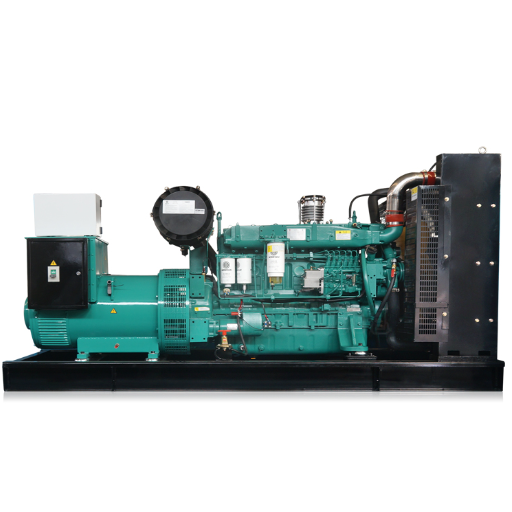
Most industrial sets in this range are high-speed machines, running at 1,500 rpm for 50 Hz or 1,800 rpm for 60 Hz. They’re light for their output, they start quickly, and they’re what you buy for standby, prime and containerised power.
That engine family tops out somewhere between 3 and 4.5 MW per unit. At 3 MW you’re no longer choosing from the middle of a range. You’re specifying at its ceiling, and that has consequences no datasheet lists.
What the Top of the Frame Costs You
Three things get harder at the top of a range.
- Lead time. The largest frames are built to order more often than the mid-range units, so the twelve-week quote you got for a 1 MW set can become six to nine months.
- Parts commonality. A 3 MW unit shares less with the 500 kW sets in the same family. Filters, injectors and turbochargers are specific to the frame and move less often through distributors.
- Service familiarity. Not every field technician has commissioned a 3 MW set. Ask who will attend the first start, and where they’re based.
None of this makes 3 MW a bad choice. It makes it a choice you plan for rather than a bigger version of a familiar purchase.
Daniel, an EPC project engineer, learned that on a mine expansion in 2025. The electrical study called for a single 3 MW unit, and the quotation was competitive. The lead time wasn’t: nine months against a site programme that assumed four. The project split the load into two 1.5 MW sets, took delivery in five months, and gained a spare in the process.
What Changes Above 3 MW
Above roughly 3 to 4 MW, the single high-speed unit stops being the obvious answer. There are three alternatives:
- Parallel several smaller sets.
- Move to a medium-speed engine.
- Buy a plant rather than a generator.
Medium-speed engines run at about 500 to 1,000 rpm and can be rated from half a megawatt to more than 20 MW. They’re power station prime movers: several metres tall, hundreds of tonnes with their generator, and built for baseload rather than for a mains failure.
If your requirement is genuinely above 3 MW, the decision is no longer about one machine. Our guide to what changes above one megawatt covers the 4 MW and 10 MW cases. The 2 MW generator article covers the rung below this one. Cummins publishes a 1,500 to 3,500 kW range that shows how the platform ladders sit end to end.
What a 3 MW Generator Weighs and How It Ships
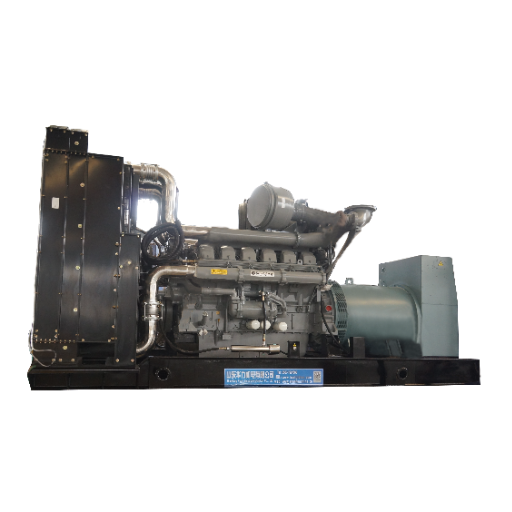
This is where 3 MW separates itself from 2 MW. A 2 MW set is the largest thing on most sites. A 3 MW set is an oversize load on many of them.
Caterpillar’s C175-16, rated 3,000 to 3,100 kW, is a useful reference because its dimensions are published. A Cat dealer lists it at 245 to 304 inches long, 90 to 104 inches wide and 95 to 132 inches high, with a skid weight of 42,750 to 50,750 lb.
| Measure | Imperial | Metric |
|---|---|---|
| Length | 245 to 304 in | 6.22 to 7.72 m |
| Width | 90 to 104 in | 2.29 to 2.64 m |
| Height | 95 to 132 in | 2.41 to 3.35 m |
| Skid weight | 42,750 to 50,750 lb | 19.4 to 23.0 t |
Weight and the 40-Foot Container Ceiling
A nominal 40-foot high-cube container measures about 12.03 m long, 2.35 m wide and 2.69 m high inside. Compare that with the table above.
- Height is the binding constraint. A set standing 3.35 m high will not enter a 2.69 m container, even before an enclosure is added.
- Width comes next. At 2.64 m the widest configuration exceeds the 2.35 m internal width.
- Weight is usually acceptable. Container ratings of 26 to 30 tonnes cover a 23-tonne set, but not a full fuel tank.
So a 3 MW set ships as an open skid on a flat rack, as a purpose-built enclosure on a low-bed trailer, or as a containerised package. In that last case the package is designed around the set, not around the container. That decision belongs in the transport plan, not in the week before dispatch.
Cranes, Foundations and Access
A 23-tonne lift is a planned operation, not delivery-day improvisation. Three items decide whether it works.
- Crane capacity at radius. The load chart that matters is the one at the radius you’ll actually work, not the maximum rating.
- Foundation loading. This mass, plus a base frame and fuel, produces point loads the slab has to be designed for.
- Route. Bridge limits, overhead lines, gate widths and turning circles decide the trailer, and the trailer may decide the enclosure.
Amina, a logistics manager on a hospital campus project, ran the route survey after the order was placed rather than before. The chosen low-bed could not pass a weight-restricted bridge on the direct route. The detour added 90 km and a police escort, which added two weeks to a programme with no float. A survey at quotation stage would have cost a day.
Fuel at 3 MW: 700 Litres an Hour, and When Gas Wins
A 3 MW diesel set at full load burns roughly 700 to 770 litres an hour. Specific fuel consumption in this class is typically 195 to 215 g/kWh, and diesel at about 0.84 kg per litre converts that mass into volume.
| Load | Power (kW) | Fuel use (L/h) | Where it fits |
|---|---|---|---|
| 100% | 3,000 | 696 to 768 | Prime or continuous duty |
| 75% | 2,250 | 522 to 576 | Typical loaded operation |
| 50% | 1,500 | 348 to 384 | Light load, poor efficiency |
Calculated from 195 to 215 g/kWh at 0.84 kg/L. Confirm against the datasheet of the engine you specify.
At full load that’s around 17,000 litres a day. A road tanker carries 20,000 to 30,000 litres, so continuous operation means a delivery every day or two, plus on-site storage sized for the interval.
Fuel storage is a design scope, not an accessory. NFPA 110 sets requirements for emergency power fuel systems, including capacity for the system class, and the NFPA 110 standard is the reference most projects cite.
When gas wins. At 3 MW the gas alternative becomes credible. Caterpillar’s CG260-12 gas generator set is listed at 3,000 ekW, the same class of machine on a different fuel. Operating cost per kWh is usually lower and the maintenance interval is often longer.
The condition is infrastructure. A gas set needs a pipeline connection or a liquefied gas supply, and neither is a decision a generator supplier can make for you. If the site has gas, compare the two on total cost over the operating hours. If it doesn’t, diesel is the answer and the fuel logistics above are your real constraint.
What to Put on a 3 MW Generator RFQ
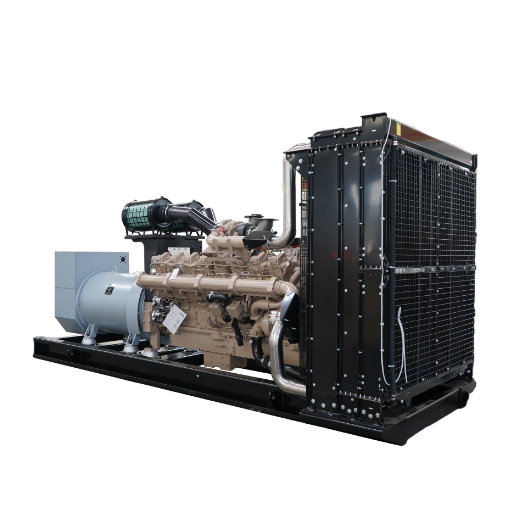
A 3 MW enquiry without site conditions produces a quotation that will be reissued. The supplier has to assume a rating, an ambient, an altitude and a connection, and every assumption is a change order later.
The Seven Items Buyers Leave Off
- Duty and hours. Standby, prime or continuous, and the expected hours per year.
- Site conditions. Maximum ambient temperature, altitude, and whether the set sits indoors or outdoors.
- Voltage and fault level. Connection voltage, required fault level, and whether a step-up transformer is in scope.
- Fuel. Type, storage capacity, refill interval and whether a day tank is required.
- Transport route and lifting. Access width, crane position, and whether the set must be containerised.
- Paralleling and switchgear. Whether the set runs alone or with others, and who supplies synchronising and protection.
- Load schedule. The load list with motor starting, not just a total in kW.
A procurement lead on a data centre fit-out added items 2 and 7 to an RFQ at the last minute. The ambient figure moved the required rating by 200 kW, and the motor starting data changed the alternator from a standard frame to a high-reactance one. Both changes were absorbed before order. Left to the change-order stage, they would have cost months.
Frequently Asked Questions
How much does a 3 MW generator cost?
A new 3 MW diesel set typically falls between USD 350 and 550 per kW before transport, installation and switchgear, which puts the machine itself at roughly USD 1.05 million to 1.65 million. Gas sets and containerised packages sit in a similar band, and used units trade well below it. Treat the range as a planning figure and quote the project.
What is a 3 MW generator used for?
The common applications are data centre halls, hospital campuses, manufacturing plants, mines and microgrids. In each case the set is either the whole site load or one module of a larger plant, and the duty is usually standby or prime rather than continuous.
Is a 3 MW generator one unit or several?
It can be either. A single 3 MW set is the simplest installation and the cheapest per kW. Two 1.5 MW sets or three 1 MW sets cost more but provide redundancy and easier transport. The decision usually turns on site access and on whether the load can tolerate a single failure.
What is the difference between 3 MW and 3,000 kVA?
At a 0.8 power factor, 3 MW is 3,750 kVA. A 3,000 kVA set delivers 2,400 kW, so it’s 20% smaller than a 3 MW requirement. Compare quotations in kW, and check the power factor and rating category they were calculated from.
Conclusion
A 3 MW generator is 3,000 kW and 3,750 kVA, and the number that decides the project is often not the power at all. It’s the 4,511 A at 480 V, the 23 tonnes on the trailer, the 3.35 m height that won’t fit a container, and the fuel delivery every day or two.
Three questions settle most of it:
- What duty will the set run, and for how many hours a year?
- What can the site physically accept, in access, lifting and foundation?
- What fuel supply exists on site today?
Answer those and the specification writes itself. Leave them open and the quotation will be written for you, by assumptions you didn’t choose.
Send us your load schedule and site plan, and our engineers will confirm the rating, the voltage and the transport envelope before anything is ordered.
