
Generator frequency drops under load are normal when the dip is brief and the reading recovers. Frequency that settles low, sags over minutes, or hunts around the setpoint is a fault, and the cause usually sits in the engine speed-control loop, not the alternator.
A controller reading 47 Hz on a 50 Hz set looks like a generator failure. Most of the time it’s a load, governor, fuel, or air problem that a technician can isolate in about an hour with a load log and a meter.
Consider a quarry we’ll call Oti. Its 500 kVA set carried a 160 kW jaw crusher and two conveyors. When the operator started the crusher and both conveyors together, frequency dipped to about 46.9 Hz, voltage fell with it, and the set recovered after two seconds. The maintenance team wanted to replace the generator.
A load log told a different story. The block start added more kW than the engine could pick up cleanly from its base load. Starting the crusher, then each conveyor 20 seconds apart, held 49.8 Hz through the same work.
The generator was healthy. The start sequence was not. The scenario is illustrative, but the pattern is common in quarries, cold stores, and water plants.
Two control loops run a generator set. The governor meters fuel to hold engine speed, and frequency follows that speed. The automatic voltage regulator, or AVR, trims excitation to hold voltage; Depco’s guide to voltage versus frequency regulation explains the split.
When the hertz reading falls, diagnose the engine side first. A voltage sag without a frequency sag belongs in our generator voltage drop under load guide.
Shandong Huali Electromechanical builds diesel generator sets from 8 kVA to 4,000 kVA and load-tests every unit before delivery in a 20 MW test center. If your controller reads low Hz under load, send our engineers a photo of the kW, Hz, and load reading. We’ll tell you whether it’s normal droop or a fault.
Key Takeaways
– Frequency is engine speed. On a four-pole alternator, 1,500 rpm gives 50 Hz and 1,800 rpm gives 60 Hz.
– A brief dip of a few hertz on a sudden load step is normal. A reading that settles low, sags over minutes, or hunts is not.
– A droop governor falls 3 to 5 percent from no load to full load by design. A 3 percent droop on a 60 Hz set reads about 61.8 Hz at no load and 60 Hz at full load.
– Log kW and Hz together at no load, half load, near full load, and across one controlled step before you adjust anything.
– Fix in order: load, governor, fuel, air, engine power. Never raise the no-load speed to hide a droop.
Generator Frequency Drops Under Load: Normal or a Fault?
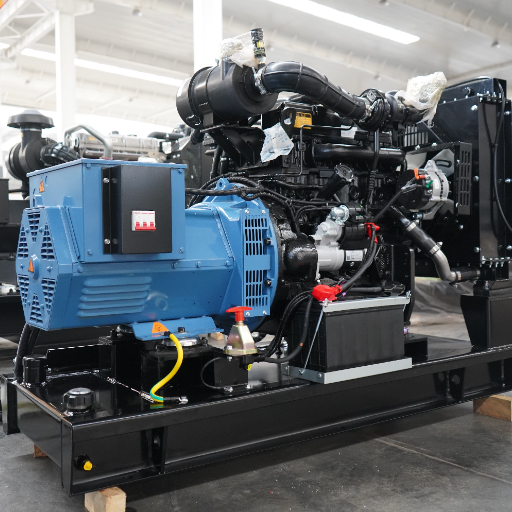
Frequency is the speed of the engine, measured in hertz (Hz), not a separate electrical setting. Diesel generator frequency drops under load follow the same rule: the engine can’t hold its speed. A four-pole alternator needs 1,500 rpm for 50 Hz and 1,800 rpm for 60 Hz.
A six-pole machine needs 1,000 rpm and 1,200 rpm for the same two outputs. The formula is rpm = Hz × 120 ÷ poles.
That relationship explains the first rule of diagnosis. If the controller shows low Hz, the crankshaft is turning slowly. Look at what is loading the engine, what is limiting its fuel or air, and what is supposed to be controlling its speed.
Governors are set one of two ways. A droop governor lets speed fall a little as load rises, so several sets can share load in proportion. Woodward’s speed droop application note puts the usual band at 3 to 5 percent from no load to full load.
On a 60 Hz set, 3 percent droop means about 61.8 Hz at no load and 60 Hz at full load. Five percent droop means about 63 Hz at no load. On a 50 Hz set, the same settings put no load at about 51.5 Hz or 52.5 Hz.
A 50 Hz set on 3 percent droop that reads 51.5 Hz at no load and 50.0 Hz at full load is behaving as designed. The same set reading 47 Hz at 60 percent load is not.
A single set running alone is usually isochronous. The governor returns to 50.00 or 60.00 Hz after each load change. On an isochronous set, a steady 47 Hz under load is a fault, not a setting.
On a droop set, settling a few percent low at full load can be the design working as intended. Know which mode you run before you call the governor broken; the generator governor droop setting is doing its job.
The transient dip is the part that alarms operators. Even a healthy set slows for a moment when a block load lands, because the governor reacts after the engine slows.
A dip of a few hertz that recovers within a second or two is ordinary on many industrial sets. How far it dips and how fast it returns is what the performance class specifies. Our generator fails load bank test article covers the formal stepped test and the failure signatures.
The 60-Second Triage: Three Questions Before You Touch Anything
Before you open a panel, answer three questions from the controller history or a short test run. When generator frequency drops under load, the answers separate a normal transient from a load problem, a governor problem, and a fuel or air problem.
Question 1: Does the frequency recover after the load step? If it dips and returns to its previous value within a second or two, the set handled the step. If it stays low, the governor or the engine could not catch the load.
Question 2: Does frequency track load in a straight line? If Hz falls gradually as kW rises and settles at a repeatable value, you’re seeing droop by design. Or the set is running near its rating. If it falls much further than the droop setting predicts, the governor or fuel system is losing authority.
Question 3: Does frequency sag over minutes or hours at a steady load? A slow drift downward is the classic fuel or air restriction signature. The engine is asking for more fuel than the line can deliver, and the gap grows as the tank empties or the filter loads.
One more question helps when the reading is unstable rather than low: does the needle or digital value hunt around the setpoint? Generator hunting under load points to the governor, its actuator, its speed pickup, or a fuel supply that is fluctuating.
If the set shuts down instead of settling, go to the protection section before you change any setting. A low-frequency trip is a protective action, and the setpoint matters as much as the cause.
What Kind of Load Causes the Drop?
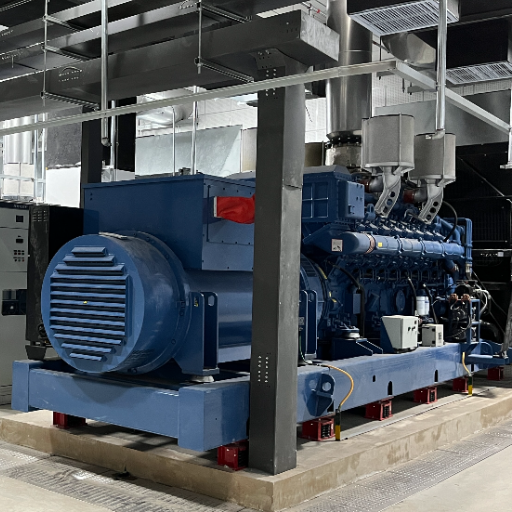
The same Hz drop means different things on different loads. A resistive heater is a clean kW step. A motor is a kW step plus a large starting kVA demand.
A rectifier or variable frequency drive (VFD) bank distorts current without adding much real power at the moment of the step. A welding set adds rapid, erratic blocks.
Motor starting is the most common load-side cause. A direct-on-line motor can typically draw about six times its full-load current at start, at a starting power factor of roughly 0.2 to 0.4.
The kW step slows the engine, so frequency dips. The kVA step pulls terminal voltage down, so voltage dips too.
The frequency part is an engine and governor problem. The voltage part is an alternator and AVR problem. Our generator trips when motor starts article covers the trip side of that event.
VFD and rectifier loads draw current in short pulses. They can add harmonics and voltage distortion, and they can confuse a controller that samples voltage for its frequency reference. The hertz reading may look unstable even when engine speed is steady, which is why a generator frequency fluctuation under load can appear on the meter without a governor fault. Check with a hand meter and a power quality analyzer before you tune the governor.
Welding sets are intermittent block loads. Frequency dips each time the arc strikes and recovers when it breaks. If the welder runs from the same set as other sensitive equipment, stage the work or isolate the welder.
Single-phase loads on a three-phase set can unbalance the phase currents. The engine sees a changing load, and the alternator sees a negative-sequence component. Frequency may hunt while voltage regulation suffers. Clamp each phase and compare.
Resistive loads such as heaters and furnaces are the simplest case. They add kW in a step, frequency dips in proportion, and the governor either catches it or doesn’t. If a heater bank causes a large dip, the set is likely undersized for the step, not broken.
Capacitive or leading power factor loads tend to raise voltage rather than lower frequency. If voltage rises while Hz holds, look at power factor correction or a lightly loaded set, not the governor.
| Load type | What the Hz reading does | First check | Usual fix |
|---|---|---|---|
| Direct-on-line motor | Sharp dip, then recovery; may trip | Starting kVA against set rating | Stage starts, soft starter, or VFD |
| VFD or rectifier bank | Step plus unstable reading; harmonics | Hand meter and power quality | Filter, active front end, or resize |
| Welding set | Erratic dips synced to the arc | Duty cycle and kW step | Isolate the welder or stage work |
| Single-phase load | Hunting with uneven phase current | Clamp each phase | Redistribute the load |
| Resistive heater | Clean dip proportional to kW | kW step against rating | Stage the bank or shed load |
| Capacitive load | Voltage rise, Hz roughly steady | Power factor | Adjust correction or set loading |
Generator Frequency Drops Under Load: Read the Signature
Stop guessing and match the pattern across one load change to a row below. This is the same logic a technician uses on a load bank, applied to a set running in service.
The load bank testing guide covers the formal stepped test. This table is for the set already carrying a facility.
| What you observe | Most likely cause | First checks |
|---|---|---|
| Brief dip of a few Hz on a big start, recovers in a second or two | Normal governor response to a block step | Stage the start; compare the dip to the class limit |
| Hz settles a few percent low and tracks load, kW near rating | Overload, or droop governor by design | Confirm kW against rating; check no-load Hz and droop mode |
| Hz settles low on an isochronous single set | Governor setpoint, linkage, actuator, or fuel | No-load Hz; linkage and actuator; fuel delivery |
| Hz sags slowly over minutes or hours at steady load | Fuel or air restriction | Filters, tank vent and pickup, lift-pump pressure, air filter |
| Hz hunts or oscillates around the setpoint | Governor instability, speed pickup, or fluctuating fuel | Linkage, gain, pickup gap, fuel pressure |
| Hz and voltage collapse together, engine lugs | Overload or the engine cannot make rated power | Real kW; smoke color; fuel and air; turbo and injectors |
| Set shuts down on low frequency under load | Under-frequency protection or overload | Real kW against rating; alarm and shutdown setpoints |
A slow sag deserves special attention because it’s easy to misdiagnose. Consider a hospital we will call St. Luke’s, running a 300 kVA prime set. Frequency was fine in the morning and sagged a little more each afternoon until the controller tripped on low frequency near the evening peak.
Governor adjustments changed nothing.
A lift-pump pressure check found a loaded primary filter and a tank vent restricted enough to pull a vacuum as the tank emptied. The engine was being starved at the exact time it needed the most fuel. Clearing the vent and changing the filter held 50.0 Hz through the next peak. Slow, steady sag is a fuel and air story far more often than a governor story.
If the frequency falls with black smoke behind it, the engine is getting fuel but not enough air, or the load is beyond what the engine can burn cleanly. Our diesel generator black smoke under load guide covers that signature. Don’t tune the governor to compensate for a fuel or air restriction.
How to Measure Frequency Under Load
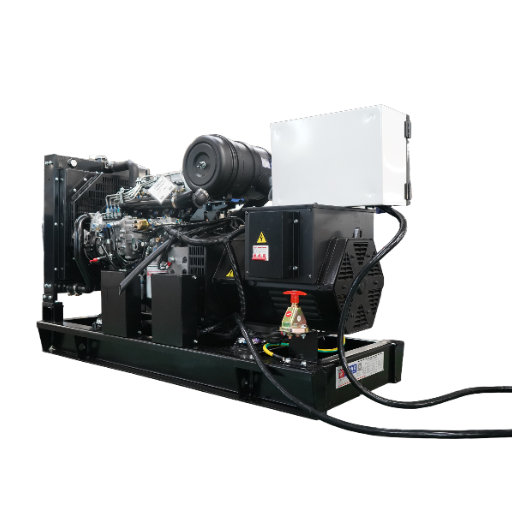
A diagnosis is only as good as the numbers behind it. Controllers are convenient, but a controller can misread one channel and send you after the wrong component. Measure both kW and Hz, and confirm the reading with a second instrument when the result matters.
- Use the controller and a hand meter. Record Hz from the controller and from a true-RMS meter on the same phase. If they disagree, the controller’s sensing or calibration is part of the problem.
- Log kW, not just Hz. Frequency faults only make sense against real load. If the controller shows low Hz while kW is near zero, you may be watching a lightly loaded motor bus or a sensing error, not a governor fault.
- Take four points. Record at no load, about half load, near full load, and across one controlled block step. The shape of the curve tells you more than any single reading. A straight line that matches the droop setting is normal. A curve that falls away at the top end points to fuel, air, or engine power.
- Record recovery time. Note how far the frequency dips and how long it takes to return. A deep dip that recovers in one second is a different problem from a shallow dip that never recovers.
- Check the pole count before you convert. The formula rpm = Hz × 120 ÷ poles only works with the right pole number. Four-pole and six-pole machines are common, but older or special alternators may differ. The nameplate settles it.
A simple log sheet with five columns is enough: time, kW, Hz at the controller, Hz at the hand meter, and what changed. Photograph the controller screen at each point. That record lets an engineer separate normal droop from a fault without visiting the site.
Why Generator Frequency Drops Under Load: The Fix Order
Fix the cause the signature names, in the cheapest and safest order. Don’t start with the governor gain just because it’s adjustable. Most frequency complaints end at the load, the fuel filter, or a loose linkage.
- Governor first when the signature says governor. Confirm the mode. A single set should be isochronous unless it parallels. Check the no-load setpoint, then the droop setting, then the linkage and actuator for wear or binding. On an electronic governor, check the magnetic pickup gap and its wiring before you touch gain. Gain is the last adjustment, made in small steps with a load on the set.
- Fuel. Work the sequence in our diesel generator fuel system maintenance guide: primary and secondary filters, tank vent and pickup, lift-pump pressure, air ingress, and fuel quality. A slow sag that appears only when the tank is low or the day is hot is a fuel delivery clue, not a governor clue.
- Air and exhaust. A clogged air filter, a collapsed intake hose, or high exhaust backpressure derates the engine quietly. The loss often shows only as load climbs. Check the filter restriction indicator and measure backpressure if the set has a tap.
- Engine power. Worn injectors, low compression, a tired turbocharger, or a fuel-stop limit can leave the engine short of its rating. Falling speed with black smoke points here. So does a set that ran well at 60 percent load and can’t hold frequency at 90 percent.
- The load side. If the load is the problem, don’t rebuild the generator. Stage the big starts, add a soft starter or VFD, shed non-critical load, or resize the set. Our guide to choosing diesel generator size covers the sizing math and the difference between running kW and starting kVA.
The most common self-inflicted wound is raising the no-load speed to hide droop. In one illustrative case, a rental company technician did exactly that for a set that sagged under load. The set then read a healthy 50 Hz at full load, but every time the breaker opened, the engine ran past 52 Hz and tripped on high frequency.
The added no-load speed had removed the governor’s headroom. The real cause, a dirty fuel filter, was still there. A new filter and a correct calibration restored stable frequency and a clean load drop.
When Low Frequency Trips the Set: Protection, Not Panic
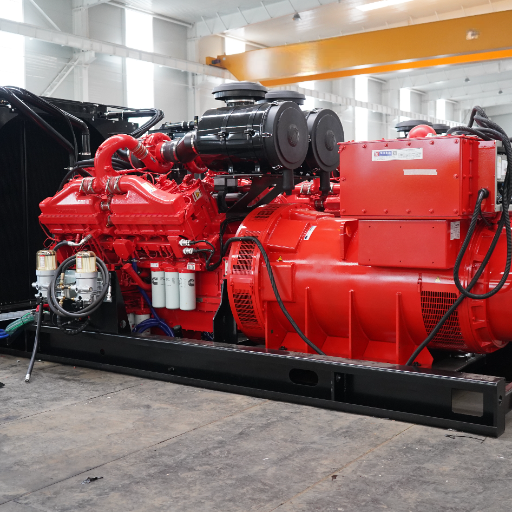
Every controller guards the set against running too slow. A diesel loses cooling and oil pressure as speed falls, and connected motors overheat. Under-frequency protection is controller-specific, so read the manual.
The bands aren’t universal. A generator low frequency shutdown is a protective action, so respect it.
Generator protection relays and controllers use a staged pattern. A Siemens 7UT613 generator protection relay manual gives one setting example with three stages.
| Stage | 50 Hz example | 60 Hz example | Example delay |
|---|---|---|---|
| Warning | 49.5 Hz | 59.5 Hz | 20 s |
| Disconnect | 48.0 Hz | 58.0 Hz | 1 s |
| Shutdown | 47.0 Hz | 57.0 Hz | 6 s |
Your controller or relay may use different values. Read the manual before you treat a trip as a hardware fault. The pattern is common: warn, disconnect, then shut down.
A second protection surprises people. Many digital AVRs reduce excitation when frequency falls below a knee point, holding a safe volts-per-hertz ratio for motors and transformers.
This under-frequency roll-off is why low Hz and low voltage often travel together. The voltage drop is the AVR protecting the load, not a second fault. The AVR side lives in our generator voltage drop under load guide.
Respect a low-frequency trip. If real kW sits below the rating and the set still shuts down at a plausible band, compare the setpoint with the manual before you distrust the hardware. Never bypass a shutdown to force a run. A diesel held below its safe band at full fuel rack can lose oil pressure and overheat the alternator.
Repair, Resize, or Replace?
The right answer depends on whether the set is incapable, restricted, or miscontrolled. Use the table as a first pass, then confirm with a load test.
| Finding | Decision | Next step |
|---|---|---|
| Running kW exceeds the rating, or the start step is too large | Resize, stage, or shed load | Load schedule and sizing calculation |
| Fuel or air restriction | Repair | Filters, tank vent, lift pump, air filter |
| Governor setpoint, linkage, actuator, or pickup fault | Service and calibrate | Governor service with a load on the set |
| Worn engine, injectors, turbo, or low compression | Rebuild or replace | Compression and injector test |
| AVR or sensing fault with steady engine speed | Repair the electrical side | AVR and sensing check |
| Frequency stable but voltage unstable | Voltage diagnosis, not frequency | Voltage-drop guide and AVR test |
A load bank test is the cleanest way to separate a set problem from a site problem. If the set holds frequency and voltage on a resistive load bank but fails on site, the load is the difference. If it fails on the bank, the set or its controls are the difference. Our load bank testing guide explains the setup and the pass criteria.
Captured the numbers? Send our engineers the load log, the controller screen photos, and the nameplate details. We’ll tell you whether the answer is a staging change, a governor calibration, a fuel-system repair, or a correctly sized generator.
Frequently Asked Questions
Why does generator frequency drop when load is applied?
Adding load adds torque demand on the engine. The crankshaft slows for a moment until the governor adds fuel, so frequency dips. That transient is normal. A frequency that stays low, sags over time, or hunts means the load, governor, fuel, or air path can’t keep up.
Is a small frequency drop under load normal?
Yes, in two cases. A brief dip of a few hertz for a second or two on a sudden load step is normal governor response. On a droop-governed set running in parallel, settling a few percent below the no-load value at full load is by design. A drop that keeps sagging or never recovers isn’t normal.
Why does my generator slowly lose Hz under load?
A slow sag over minutes or hours usually points to a fuel or air restriction, not the governor. Clogged filters, a blocked tank vent or pickup, a weak lift pump, or air in the fuel line starve the engine as demand rises. Check fuel delivery before you adjust the governor.
What frequency should a diesel generator run at?
A set should run at the frequency its market is built for: 50 Hz in most of the world, 60 Hz in the Americas and parts of Asia. A healthy single set on isochronous control returns to 50.00 or 60.00 Hz after each load change. A droop set settles where its setting says it should.
At what frequency will a generator trip?
There is no universal number. Controller and relay settings differ. One Siemens protection example uses 47 Hz shutdown on a 50 Hz system and 57 Hz on a 60 Hz system, with warning and disconnect stages above those values. Read your controller manual and confirm the setpoints before you treat a trip as a hardware fault.
Can low frequency damage equipment or the generator?
Yes, which is why the protection exists. Motors run slower, cool worse, and draw more current at low frequency.
Transformers can saturate, and the diesel loses cooling and oil pressure below rated speed. Under-frequency trips and AVR volts-per-hertz roll-off exist to stop that damage. Fix the cause, not the reset.
Conclusion
When generator frequency drops under load, the answer is usually on the engine speed-control side of the machine, and it’s usually not a failed generator. A brief dip on a load step can be normal. A frequency that settles low, sags over minutes, or hunts is a fault.
Voltage that falls with it may be the AVR protecting the system, not a second problem.
Log kW and Hz together. Read the signature. Test before you adjust. Fix in the order load, governor, fuel, air, and engine power. Never hide a sag by raising no-load speed, and never bypass a low-frequency shutdown. A healthy isochronous set returns to 50.00 or 60.00 Hz, and a droop set settles where its setting says it should.
If your numbers show that the load genuinely exceeds the set, or the fault is beyond your team, send our engineers your load log and controller screen photos. We will tell you whether the answer is a staging change, a governor calibration, a fuel-system repair, or a correctly sized generator.
