
A megawatt generator is any generating set rated at 1,000 kW or more. The first megawatt is a purchasing decision. Every megawatt after it is an engineering one, because above that line the constraint stops being the machine and starts being the site.
Most buyers arrive here knowing the load they need to carry and not much else. Then the first specification lands, and three questions appear that nobody warned them about.
How does it get to site? What holds it up? And how much diesel arrives every day?
This guide answers those from published figures rather than sales language. It covers 1 MW through 20 MW, explains what actually changes at each step, and says plainly where a plant stops being a machine. If you want the short version, the answer is: somewhere between 2 MW and 4 MW, transport takes over the design.
One thing to state at the start. Our own large-frame range runs from 1,200 kW to 1,500 kW to 1,600 kW, and we publish datasheets for those frames. Everything above 1,600 kW in this guide is written from third-party manufacturer data, not from our catalogue.
We would rather say that than imply otherwise. If your project sits above our range, our engineers will still tell you what fits and what does not.
Key Takeaways
- A megawatt generator is 1,000 kW or more, which is 1,250 kVA at 0.8 power factor. Vendors describe the same machine three ways.
- A 1 MW open set weighs about 9.2 tonnes. A 2 MW set weighs 14.5 to 18.3 tonnes. A 4 MW set weighs 25 to 30 tonnes and reaches 3,264 mm wide.
- A 40-foot high-cube container is 2,352 mm wide inside. The 2 MW class clears it by tens of millimetres. The 4 MW class does not clear it at all in most configurations.
- Fuel scales linearly and stops being a cost line. A 10 MW plant burns roughly 2,500 litres an hour, or about 60,000 litres a day.
- Above roughly 4 MW there is no single high-speed diesel unit to buy. A 10 MW diesel plant is normally four 2.5 MW sets or ten 1 MW sets, in containers, with switchgear between them.
What Counts as a Megawatt Generator
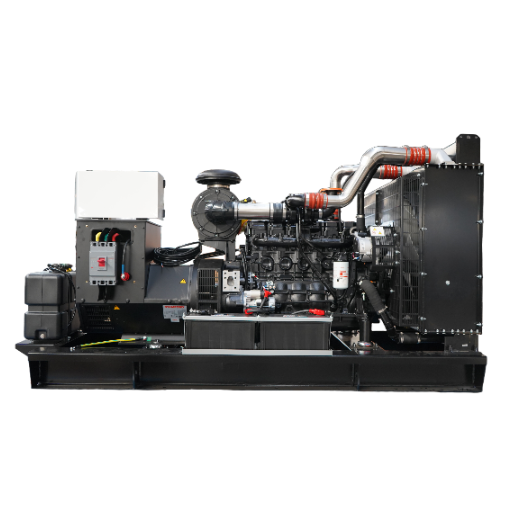
Every megawatt generator datasheet lists three numbers for the same machine, and the listing decides which one you see.
Kilowatts measure real power, the part that does useful work. Kilovolt-amperes measure apparent power, which includes magnetising current the load draws without converting. The ratio between them is the power factor, and 0.8 is the convention for generator sizing.
So 1,000 kW is 1,250 kVA at 0.8 power factor. A set advertised as a 1,250 kVA machine and a set advertised as a 1,000 kW machine may be the same alternator in the same frame.
That translation matters more at scale than it does for a 100 kW set, because at a megawatt a ten percent power factor error is 125 kVA of capacity. A megawatt generator bought against the wrong figure is expensive in both directions. Our kVA vs kW guide has the arithmetic if you need the working.
The size ladder, and where the steps stop being incremental
Below 1 MW, each step up is mostly a bigger version of the same arrangement. Above 1 MW, each step changes something structural. A megawatt diesel generator at 1,000 kW and one at 4,000 kW share a nameplate convention and almost nothing else.
| Rating (kW) | kVA at 0.8 PF | Dry weight | Typical length | Fits a 40-foot container? |
|---|---|---|---|---|
| 1,000 | 1,250 | 9,225 kg | 5,100 mm | Yes, with clearance |
| 2,000 | 2,500 | 14,470 to 18,290 kg | 5,928 to 6,377 mm | Barely, on width |
| 4,000 | 5,000 | 25,000 to 30,000 kg | up to 8,409 mm | Not at full width or height |
| 10,000 | 12,500 | No single unit | n/a | Built as a plant |
The 1 MW and 2 MW rows come from datasheets. The 4 MW row is a Caterpillar C175-20, rated 3,150 to 4,000 ekW, and its published envelope runs to 8,409 mm long, 3,264 mm wide and 3,828 mm high. The 10 MW row is not a missing datasheet. It is the point where the industry stops building a single megawatt generator.
What Changes at 1, 2, 4 and 10 MW
At 1 MW the machine is still a machine. It arrives on a flatbed, lifts with a mid-size crane, and sits on a foundation you could describe in a paragraph.
Our own 1,200 kW set is 5,100 mm long and 9,225 kg open, or 7,500 mm and 17,000 kg with a soundproof canopy. Both fit an ordinary doorway conversation. The 1 MW generator guide covers the detail.
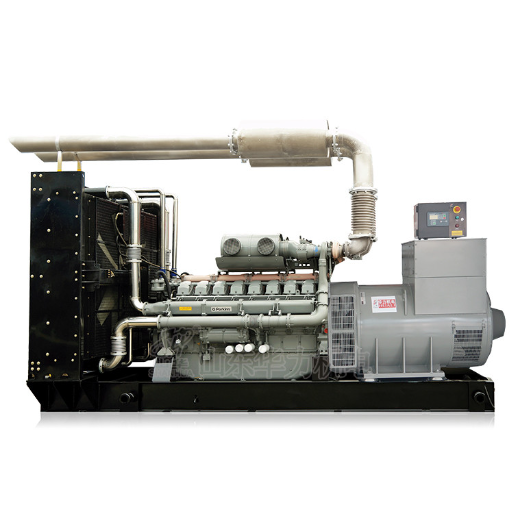
At 2 MW the machine is the largest thing on site. A representative 2 MW diesel generator set runs 5,928 to 6,377 mm long and weighs 14,470 to 18,290 kg dry. Add a base-frame tank for a day of running and you add several tonnes of diesel. The crane is now a planned operation with a lift study, and the foundation is a civil scope.
At 4 MW the machine stops fitting normal things. The Caterpillar C175-20 weighs 25,000 to 30,000 kg and reaches 3,828 mm high in its largest configuration. That is taller than a shipping container, wider than a road lane, and heavier than most site cranes will lift at radius. It ships as an oversize load with permits and probably an escort.
At 10 MW there is no machine in the class most buyers shop in. Search for a 10 MW diesel generator and you will find plants, not sets. The common configurations are four 2.5 MW units in 40-foot containers, or ten 1 MW containerised units. Clarke Energy, for example, supplied a 10 MW plant to the Central African Republic as four Kohler-SDMO KD3500-F sets in containers.
Why engine speed decides the ceiling
The four-megawatt limit is not a law of physics. It is a limit on one kind of engine, and that explains most of the confusion in this market.
The sets this guide has described so far are high-speed machines, running at 1,500 rpm for 50 Hz or 1,800 rpm for 60 Hz. They are light for their output, they start quickly, they take load in seconds, and they are what you buy for standby, prime and containerised power. The mainstream high-speed platforms top out somewhere between 3 and 4.5 MW per engine.
Medium-speed engines run at roughly 500 to 1,000 rpm and are a different animal. A single medium-speed unit can be rated from half a megawatt to more than 20 MW, so on paper a 10 MW engine exists. In practice it is a power station prime mover: several metres tall, hundreds of tonnes with its generator, bolted to a concrete block that is itself an engineering project, and built to run baseload for decades rather than to start on a mains failure.
That distinction answers a question the size ladder raises and does not settle. If you need 10 MW of continuous industrial power for a factory or a mine, a medium-speed unit is a legitimate option and worth pricing. If you need 10 MW of standby or islanded power that must start on demand and be shipped to site, you are in the high-speed world, and high-speed units are built from smaller sets.
At 20 MW and above
At 20 MW the answer is not a bigger engine but a different industry. Plants at that scale are normally multiple medium-speed units in a hall, or gas turbines, or a hybrid of both. Diesel at 20 MW is a fuel bill somewhere north of 5,000 litres an hour and a supply chain with its own logistics. At this point the useful question is no longer which generator but whether diesel is the right prime mover.
That is the pivot the whole guide turns on. In the high-speed class that serves standby and prime power, a megawatt generator is something you buy up to about 4 MW. Above that you are buying an arrangement of generators, a switchboard, and a fuel depot.
Weight, Transport and Site Access Above 1 MW
The container ceiling
Containers are the cheapest way to move heavy equipment across an ocean, so they quietly set the design. A standard 40-foot high-cube container is 12,032 mm long, 2,352 mm wide and 2,698 mm high inside, with a door opening of 2,340 mm by 2,585 mm and a payload ceiling near 28,750 kg. For a megawatt generator, that box is not a packaging choice. It is the limit of what you can ship without a permit.
Put the ladder against those numbers.
A 2 MW set at 2,286 mm wide clears the 2,352 mm internal width by 66 mm. That is 33 mm a side. Through the door it is tighter still, at 54 mm total. The set goes in at the factory and comes out at the site, and nobody opens the doors in between.
A 4 MW set at up to 3,264 mm wide and 3,828 mm high does not go in at all in that configuration. At its smallest published build it is 2,336 mm wide and 2,536 mm high, which does clear. The same engine ships as a container cargo or as breakbulk depending on radiator and enclosure choices made years before your order.
Two 2 MW sets also exceed one container’s payload: at 14,470 kg each they total 28,940 kg, over the 28,750 kg ceiling before fuel or frames. A two-unit megawatt plant is always two containers at minimum.
Cranes, foundations and access
Lifting a megawatt generator is the next constraint, and it is the one that most often arrives late in a project.
A 2 MW set lifts by skid-mounted points with a spreader beam, typically from a 50 to 100 tonne mobile crane. A 4 MW set needs more, and needs the crane positioned where the ground will take it. Where the machine has to be set inside a building, it usually goes in before the roof.
The foundation carries dynamic load, not just static mass. Unbalanced forces, vibration isolation and soil bearing all belong in the civil design, and none of them appear in a generator quotation.
Access is the quiet killer. Measure the narrowest gate, the door into the plant room, and the turning radius before you specify anything.
In one project we were asked to review, a 2 MW set had been ordered and paid for before anyone measured the site entrance. The set was 2,286 mm wide. The gate was 2,100 mm.
The machine was unloaded a quarter of a mile away and the project spent six weeks on a new access road. That is a composite example, not a named customer, but the failure mode is common.
Fuel, and Why It Becomes a Logistics Problem
Fuel for a megawatt generator burns roughly in proportion to output, which sounds obvious until you multiply it by a plant.
A modern large diesel engine uses around 200 to 215 grams of fuel per kilowatt-hour. At a diesel density near 0.85 kg per litre, that works out to roughly 0.25 litres per kWh produced. Multiply by rating and load.
| Rating | Full-load fuel | Per 24 hours | Tank for 48 hours |
|---|---|---|---|
| 1,000 kW | ~250 L/h | ~6,000 L | ~29,000 L |
| 2,000 kW | ~500 L/h | ~12,000 L | ~58,000 L |
| 4,000 kW | ~1,000 L/h | ~24,000 L | ~115,000 L |
| 10,000 kW | ~2,500 L/h | ~60,000 L | ~288,000 L |
Those are planning estimates from the method on our fuel consumption table, not a datasheet value for any one model. Real engines run a little higher. Our own 1,200 kW set burns 309 litres an hour at full prime load, which is 0.258 litres per kWh rather than the 0.25 rule.
Read the right-hand column again. A 10 MW plant needs almost 300,000 litres of storage for two days of running.
That is not a tank, it is a small terminal, with bunding, fire separation, delivery access for road tankers and a supply contract. At 1 MW, fuel is a line in the budget. At 10 MW, fuel is a project in its own right.
Part-load operation makes it worse per unit of output, because fixed losses stay constant while power falls. Running a megawatt generator at 25 percent load roughly doubles the fuel cost per kWh and causes wet stacking in the engine.
Megawatt Generator Sizing: One Large Set or Several
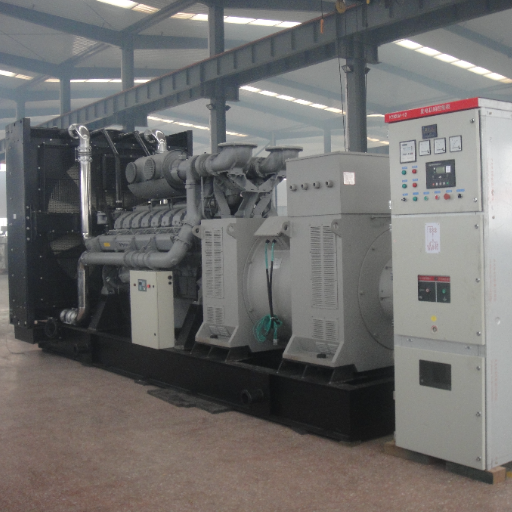
Sizing a megawatt generator is the question buyers ask second and should ask first. The answer flips as the rating climbs.
When one large set wins
One set wins whenever the machine fits and the load is steady.
You need one foundation, one switchgear line-up, one fuel system, one exhaust and one control point. Footprint and civil works drop. Maintenance hours drop because there is one engine to service. At high steady load a single larger set is more efficient per kWh than two smaller ones running part-loaded.
If the site can accept the machine, one set is usually cheaper and simpler, up to about 2 MW.
When several smaller sets win
Beyond about 4 MW the question stops being a choice, because single diesel units largely stop existing at that scale. A 10 MW plant is a set of sets, and the design work moves from selecting a machine to arranging several.
Two reasons favour multiple units even below that line. The first is reliability: two units give N+1 capability, so one can be serviced while the other carries load. A single set gives you a scheduled outage instead. Our guides to one large generator versus parallel generators and to N+1 redundancy cover the commercial case.
The second is access. A 1 MW containerised generator is about 6 metres long and 12.5 tonnes. Ten of them can reach sites that one 4 MW machine cannot, one container at a time, on ordinary trucks.
The cost is complexity. Parallel sets need synchronising, load sharing, protection coordination and a control system that behaves when one unit trips. That is engineering you pay for once and maintain forever.
A project we reviewed in 2024 shows why the question has to be asked early. A buyer with a 6 MW requirement wrote a tender for “one 6 MW diesel generating set.” The two quotations that came back described two different businesses.
The medium-speed bid was a single engine on a concrete plinth inside a building, with the civil works priced separately. The high-speed bid was six containerised 1 MW units on a slab, with the switchgear in the price.
The hardware numbers were close. The civil and civil-adjacent scope was not, and nobody had asked about it in the tender. That is a composite, like the access example above, but the shape is routine.
A decision table
| Site condition | Bias toward |
|---|---|
| Machine fits through the gate and into the plant room | One set |
| Machine cannot reach the connection point | Several smaller sets |
| Load cannot tolerate a scheduled outage | Several sets, or one set plus a redundant unit |
| Steady baseload, high annual hours, mains available for maintenance windows | One set, and consider medium speed above 4 MW |
| Islanded site, no grid, no maintenance window | Several sets with N+1 |
| Budget approved on hardware only | Whichever option includes the civil works in the comparison |
The practical rule: if a single set fits the site and the load is steady, buy one. If it does not fit, or the load cannot tolerate a shutdown, design a plant and budget for the switchgear.
What a Megawatt Generator Costs
We do not publish prices and neither does anyone honest about this class of equipment. What can be said is what drives the number.
Anyone who quotes a megawatt generator price on a website without a scope list is quoting a machine, not a project. The two numbers differ by more than most buyers expect.
The engine platform moves the price more than anything else. At 1 MW, a premium European or American engine and a Chinese engine of the same rating are different purchases with different service networks.
The alternator and voltage class matter more as you climb. A megawatt set is often specified at medium voltage, which changes the alternator, the switchgear and the cable. That is a step change in cost, not a percentage.
The enclosure is the second largest block. A 1 MW open set weighs 9.2 tonnes. The same set in a soundproof canopy weighs 17 tonnes and is 2.4 metres longer. That difference is bought and shipped.
The plant around it grows faster than the machine. At 1 MW the balance of plant is a foundation and a cable. At 10 MW it is switchgear, transformers, fuel storage, control and a building.
Logistics stops being a rounding error. Moving 25 to 30 tonnes of machine internationally is a freight project with its own permits.
The honest way to compare two quotes is to put both against the same scope list. A lower number almost always means a shorter list, and at megawatt scale the missing items are expensive.
Specifying a Megawatt Generator
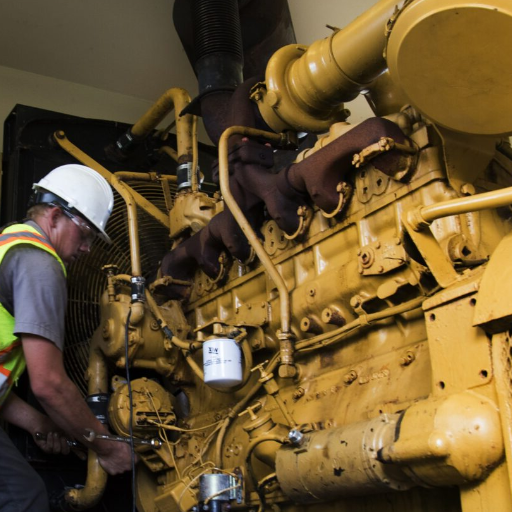
The questions that change the answer
Specifying a megawatt generator starts with the rating regime: standby, prime or continuous, to ISO 8528. A set sold as 2,000 kW standby is often about 1,820 kW prime. Specify the wrong one and you lose nine percent of capacity before delivery.
Then state the site, because the site may overrule the load.
- Access. Gate width, door width, turning radius, crane position and the maximum single lift. Send a site plan.
- Altitude and ambient. Above 1,000 metres, or above 40 degrees Celsius, available output falls and the derating must be applied to the nameplate rather than discovered at commissioning.
- Voltage and frequency. A 2 MW class set can be offered from 380 V to 11,000 V. The voltage class changes everything downstream.
- Fuel autonomy. Hours of running required between deliveries, which fixes tank size and site layout.
- Redundancy. Whether the load can tolerate a shutdown, which decides one set or several.
- Enclosure and noise. The limit at a stated distance, and whether the stack is in scope.
A megawatt generator enquiry that answers those six gets an accurate quotation. One that says “one megawatt generator, please” gets a machine that may not fit through the gate.
What a usable brief looks like
Here is a specification a supplier can actually price, for a typical case: a data centre with a 2,400 kW critical load at 0.8 power factor in a coastal city.
Two 1,500 kW prime-rated sets at 11 kV, 50 Hz, in 40-foot containers, N+1. Load 80 percent on one set. Ambient 45 degrees Celsius, so derate and confirm the rating at site conditions. Site access: 3,000 mm gate, 12 metre turning radius, crane pad on the east side, maximum single lift 22 tonnes. Fuel: 24 hours autonomy per set, external bulk tank, bunded. Exhaust: 75 dBA at 1 metre from the enclosure. Controls: BMS integration over Modbus TCP, remote monitoring included.
That paragraph settles the machine, the enclosure, the transport, the foundation, the fuel system and the control scope, so two suppliers can be compared.
Leave out the gate width and you will get a container the site cannot accept. Leave out the ambient and you will get a nameplate rating that falls short on the day it matters.
The Step That Matters
The useful way to think about megawatt generators is not as a range of sizes but as three bands with different rules.
Up to about 1 MW, a megawatt generator is a machine you buy. It arrives, it is lifted, it is connected.
From roughly 1 MW to 4 MW, you are buying a transport and civil project with a machine attached. Weight, width, crane reach and foundation take over the specification, and the container becomes the design constraint.
Above roughly 4 MW, you are buying a plant. There is no single unit, so the work moves to architecture, switchgear and fuel logistics.
Knowing which band you are in before you request quotations is worth more than any single specification decision, because it tells you which questions to ask and which supplier to ask them of.
Behind all three bands sits the same arithmetic. A megawatt generator is a machine, a transport problem and a fuel contract at once, and size only changes which dominates.
Our published large-frame range reaches 1,600 kW, which sits in the middle band. For anything above it, we will tell you honestly whether it is a project we can take on, and if it is not, what to specify when you go elsewhere. Send us the load profile and the site plan together and we will start with the constraints rather than the catalogue. Our power range shows what we build, and the data centre and mining pages show where megawatt-class power usually goes.
