
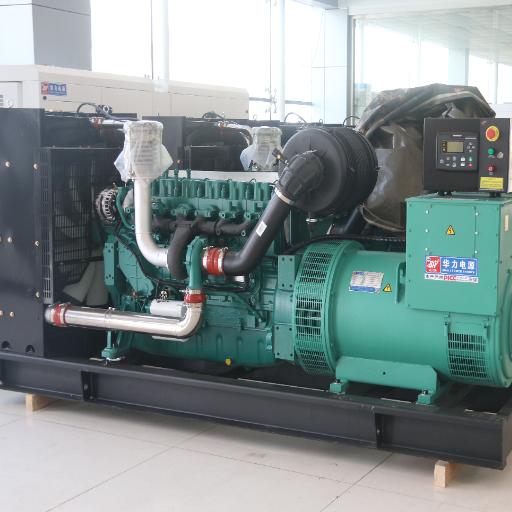
A 1 MW generator is 1,000 kW, which is 1,250 kVA at a 0.8 power factor. Physically it is a machine roughly 5 metres long and 2.4 metres tall, weighing between 9 and 13 tonnes, burning about 309 litres of diesel an hour at full load.
That last figure is the one that surprises people. Buyers budget for a generator and discover they have also committed to a fuel contract, a crane lift, and a concrete foundation.
Most first-time buyers assume a set this size is simply a scaled-up 100 kW unit. It is not. The engine grows from six cylinders to sixteen, the alternator mass climbs faster than the rating does, and the machine stops fitting through a standard doorway.
This page gives you the real numbers from our factory datasheet rather than an estimate. We build these units, so the dimensions, weights and fuel figures below are measured off the drawing, not inferred from a rule of thumb.
Key Takeaways
- A 1 MW generator is 1,000 kW or 1,250 kVA at 0.8 PF, drawing roughly 1,804 A at 400 V three-phase.
- A 1,200 kW prime-rated set weighs 9,225 kg open and 17,000 kg in a soundproof canopy.
- Fuel runs 309 L/h at 100% prime load, 238 L/h at 75%, 167 L/h at 50% and 88 L/h at 25%.
- Over 6,000 running hours, full-load fuel is about 1.85 million litres, which typically costs more than the generator.
- Our range steps 1,200, 1,500 and 1,600 kW. We do not build a unit rated at exactly 1,000 kW, and that is worth asking any supplier.
What a 1 MW Generator Actually Is
The arithmetic is simple and most buyers get it wrong by one step.
1 MW equals 1,000 kW. That part is fixed. But generators are sold in kVA, and kVA is always larger than kW because it includes reactive power. At the standard 0.8 power factor, 1,000 kW divides by 0.8 to give 1,250 kVA.
That 250 kVA gap is not a rounding error. It is 25% of the machine, and it is the single most common source of confusion when comparing quotes from different suppliers. If you want the full derivation, our guide to kVA vs kW walks through it.
Prime rating versus standby rating
The same physical machine carries two different numbers depending on how you will use it.
Prime power is the rating for continuous operation under a variable load. Standby power is the higher figure available for the duration of an outage, and it assumes the set is not running continuously.
On our HL1200GF, prime power is 1,200 kW and 1,500 kVA. Standby power is 1,320 kW and 1,650 kVA. The gap between them is 10%, and it exists because a standby set is expected to spend most of its life stopped.
The unit we actually build
Here is something no competitor will tell you: we do not make a generator rated at exactly 1,000 kW.
Our large-frame range steps from 1,200 kW to 1,500 kW to 1,600 kW. If you need 1 MW of prime power, the honest answer is either a 1,200 kW unit running at about 83% load, or a smaller frame pushed to its limit.
Running a 1,200 kW set at 1,000 kW is usually the better choice. It leaves headroom for motor starting, runs the engine in its efficient band, and extends service life. Ask any supplier what frame they would actually ship you before you compare prices.
1 MW Generator Dimensions and Weight
This is where the gap between a datasheet and a delivery truck becomes real.
Open set versus soundproof set
The same generator has two completely different footprints depending on the enclosure.
| Specification | Open set | Soundproof set |
|---|---|---|
| Length | 5,100 mm | 7,500 mm |
| Width | 1,830 mm | 2,400 mm |
| Height | 2,440 mm | 3,000 mm |
| Net weight | 9,225 kg | 17,000 kg |
The soundproof canopy adds 2.4 metres of length and 7,775 kg of mass. That is not a cosmetic difference. It changes what trailer you need, what crane you hire, and whether the unit fits through the door of the building you had in mind.
For scale, a standard ISO 20-foot container is 6,058 mm long internally. The soundproof 1,200 kW set at 7,500 mm does not fit inside one.
Why the engine alone weighs 5,360 kg
The mass is not in the enclosure or the alternator. It is in the engine.
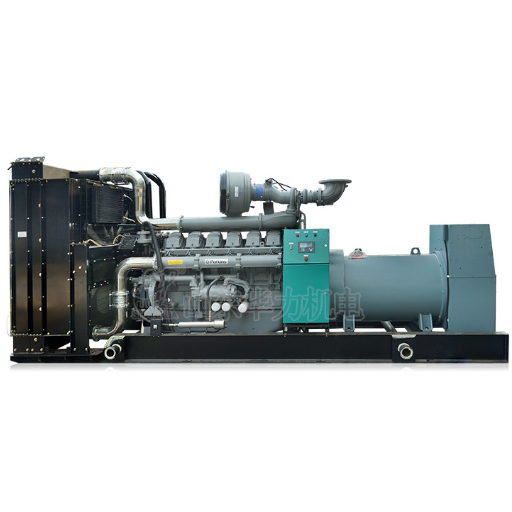
Our HL1200GF uses a CCEC Cummins KTA50-GS8: 50.3 litres of displacement across 16 cylinders, with a 159 mm bore and 159 mm stroke. That engine weighs 5,360 kg dry, before you add coolant, oil, radiator, alternator, base frame or canopy.
So when a specification sheet claims a 1,200 kW set weighs under 5 tonnes, the number cannot include a real 16-litre-per-cylinder engine. It is worth checking what was actually weighed.
What this means for access and floor loading
A 9,225 kg open set does not arrive on a pallet. It arrives on a flatbed or in a container, and it comes off with a crane or a heavy forklift.
Three things to confirm before you order:
- Door and gate width. The open set is 1,830 mm wide. The soundproof set is 2,400 mm. Measure the narrowest point on the route, not the doorway you assume they will use.
- Crane access and lift points. Lifting a 9-tonne load needs a certified plan and a suitable radius. If the plant room is in a basement, this is the constraint that decides the project.
- Floor loading. A 9,225 kg set spread over a 5,100 × 1,830 mm base frame is a concentrated load. Our guide to generator foundation design covers the bearing calculation and the vibration isolation that goes with it.
One more comparison worth having. A 1,000 kW natural gas set from another supplier lists at 12,030 × 2,440 × 2,380 mm and 13,500 kg, with a list price around $550,000. Different fuel, different enclosure, but the same order of magnitude: a 1 MW generator is a 10-tonne machine, not a 2-tonne one.
1 MW Generator Fuel Consumption
Fuel is where the machine stops being a capital purchase and becomes an operating cost.
The load band
Our HL1200GF datasheet gives fuel consumption across the load range at 50 Hz.
| Load | Fuel consumption | Litres per kWh |
|---|---|---|
| 100% prime (1,200 kW) | 309 L/h | 0.258 |
| 75% prime (900 kW) | 238 L/h | 0.264 |
| 50% prime (600 kW) | 167 L/h | 0.278 |
| 25% prime (300 kW) | 88 L/h | 0.293 |
| 100% standby (1,320 kW) | 345 L/h | 0.261 |
Read the right-hand column carefully. Fuel per kWh is lowest at full load and highest at quarter load. A lightly loaded 1 MW generator burns less fuel per hour but more fuel per unit of electricity delivered.
That is the opposite of what most operators assume. Running a big set at 25% load to “save fuel” costs more per kWh than running it at 75%.
Litres per kWh and specific fuel consumption
Divide 309 L/h by 1,200 kW and you get 0.2575 L/kWh. Multiply by diesel density of roughly 0.84 kg/L and you get about 216 g/kWh, which sits right in the normal band for a large four-stroke diesel. The US Energy Information Administration’s guide to diesel fuel covers the energy content behind that conversion.
The number that matters commercially is not grams per kilowatt-hour. It is litres per year. Our diesel generator fuel consumption chart covers the full range from 10 kW to 2,000 kW if you need to compare frame sizes.
What the fuel costs per year
Here is the calculation that changes how people think about this machine.
A 1 MW generator running 6,000 hours a year at full load burns 309 L/h × 6,000 = 1,854,000 litres. At 0.80perlitre,thatisroughly∗∗0.80perlitre,thatisroughly∗∗1.48 million in fuel annually**.
Drop to 50% average load and the figure falls to 167 L/h × 6,000 = 1,002,000 litres, or about $800,000.
Priya, a project engineer sizing backup for a processing plant, ran this calculation after her first supplier quote and found the fuel bill over five years was four times the generator price. She moved the design from one 1,200 kW unit to a pair of smaller sets so the running set could stay near 75% load. The capital cost rose by 18%. The fuel projection fell by a third.
Diesel or Natural Gas at 1 MW
The 1 mw natural gas generator option exists, and at this size it is a genuine alternative rather than a niche.
Diesel wins on availability and response. You can store it on site, the fuel is universally available, and the engine reaches full load in seconds. For standby duty, where the set may run 50 hours a year, a 1 mw diesel generator is almost always the right answer.
Natural gas wins on running cost and emissions. A gas set avoids fuel storage entirely, which removes the bunding, the tank inspections, and the diesel fuel storage regulations compliance burden. It also meets tighter emissions limits more easily, which matters under EPA stationary engine rules for non-emergency engines.
The trade-off is derating and infrastructure. A gas engine typically produces less power per litre of displacement than a diesel, and the set needs a gas supply at adequate pressure and flow. That supply is often the binding constraint.
For prime power at 1 MW, gas frequently wins on total cost. For standby, diesel usually does.
What a 1 MW Generator Costs
Unit price varies widely by engine brand, alternator, enclosure and voltage, so treat any single figure as a starting point rather than a quote.
Unit price and what drives it
At the 1 MW class, the machine itself typically runs from several hundred thousand dollars upward, with a 1,000 kW natural gas set from one supplier listed at around $550,000. Generator Source puts the initial quote for 1,000 to 4,000 kW sets at “a million dollars or more,” which is consistent once you move up the range.
Four things move the number most:
- Engine brand. A Cummins or Perkins platform costs more than a domestic equivalent and holds resale value better.
- Enclosure. The soundproof canopy adds weight and cost. Only pay for it if noise is a real constraint.
- Alternator. A Stamford or Leroy Somer machine costs more than a generic unit, and it matters more as the frame grows.
- Voltage and switchgear. Higher voltage classes and paralleling capability add cost outside the generator itself.
The costs that are not on the quote
The generator price is rarely the largest line in the project.
Transport for a 9-tonne machine, crane hire, foundation and civils, cabling, switchgear, exhaust and ventilation, commissioning, and the first fill of coolant and oil all sit outside the unit price. On a first-time installation these frequently add 30% to 50% on top.
Our guide to stationary generator cost breaks this into the four layers buyers actually pay: FOB, landed, installed and lifetime. Read it before you compare two quotes that look different.
Rent or buy
For short projects, the 1 megawatt generator rental market is real and competitive. Rental makes sense when you need the power for weeks rather than years, when the load is temporary, or when you need a bridge unit while a permanent set is on order.
The crossover usually falls somewhere between one and three years of use. Below that, rent. Above it, buy. Fuel and maintenance are payable either way, so the comparison is really about capital cost against rental rate.
A 1 mw generator for sale will usually be quoted ex-works, while a rental quote bundles delivery, hookup and service. Compare the two on installed cost per month of operation, not on the headline rate.
If you are weighing a single large unit against two smaller ones, our comparison of one large generator versus parallel generators covers the redundancy argument in detail.
If you are specifying a 1 MW generator for a live project, our engineers can review your load profile and confirm the frame size before you commit. Send us the details and we will come back with a configuration and a realistic installed cost.
Specifying a 1 MW Generator: Five Decisions
Work through these in order. Each one constrains the next.
1. Prime or standby. This sets the rating you must buy. A prime-power application needs a set rated for continuous duty, which is a larger and more expensive machine than the same kW in standby trim.
2. Voltage. Our large-frame sets are built at 400 V three-phase, four-wire. That is fine for most sites, but long cable runs at 1 MW carry very high current. At 400 V and 0.8 PF, 1,200 kW draws about 2,165 A. If the load is 300 metres away, cable cost and volt drop may push you toward a higher voltage class or a step-up transformer.
3. Open or soundproof. The soundproof set is 2.4 metres longer and nearly twice the weight. Choose it because you have a noise limit, not because it looks more finished.
4. Fuel. Diesel for standby and remote sites. Natural gas for prime power where a supply exists.
5. One large or two smaller. A single 1 MW set has no redundancy. Two 600 kW sets in parallel give you N+1 and better part-load efficiency, at the cost of more maintenance surface.
A note on rating standards. Standby classifications and their definitions are set by NFPA 110 for emergency power systems. If your installation is life-safety related, that standard, not the datasheet, determines what you must specify.
Frequently Asked Questions
How many kVA is a 1 MW generator?
1,250 kVA at a 0.8 power factor. Divide 1,000 kW by 0.8. If a supplier quotes you 1,000 kVA for a 1 MW requirement, they are quoting a different power factor and you should ask which.
How much fuel does a 1 megawatt generator use per hour?
About 309 litres per hour at 100% prime load on a 1,200 kW set, falling to 238 L/h at 75%, 167 L/h at 50% and 88 L/h at 25%. Fuel per kWh is lowest at full load.
How big is a 1 MW generator?
An open set is roughly 5,100 × 1,830 × 2,440 mm and 9,225 kg. A soundproof set is about 7,500 × 2,400 × 3,000 mm and 17,000 kg. Plan for the soundproof dimensions if noise is a constraint.
How much does a 1 MW generator cost?
The unit alone typically starts in the several hundreds of thousands of dollars, with installed cost adding 30% to 50%. The 1 megawatt generator price you are quoted will also depend heavily on whether the set is prime or standby rated, and on which engine platform sits inside it.
Can a 1 MW generator run continuously?
Yes, if it is prime-rated. A standby-rated set is not intended for continuous duty and running one that way will shorten its life and may void the warranty.
What voltage does a 1 MW generator output?
Our large-frame sets are built at 400 V, three-phase, four-wire, at 50 Hz. Other voltages are available to order, and at 1 MW the cable and volt-drop calculation often decides the answer.
Conclusion
A 1 MW generator is a 10-tonne machine that burns a quarter of a litre of diesel per kilowatt hour, and the fuel usually costs more over its life than the unit did. Get the frame size and the fuel projection right, and the rest of the specification follows.
The five things worth remembering:
- 1,000 kW equals 1,250 kVA at 0.8 power factor, and that gap is where quotes get confused.
- Weight and footprint decide the project more often than the electrical specification does.
- Fuel per kWh is lowest at full load, so sizing for headroom saves money twice.
- Installed cost runs 30% to 50% above unit price, and the extras are not optional.
- Ask what frame the supplier will actually ship. We step from 1,200 to 1,500 to 1,600 kW, and a 1,200 kW set running at 1,000 kW is usually the right answer for a 1 MW requirement.
If you are still at the sizing stage, our range of 1001 kW and up generators lists the frames and the datasheets for each. And if you would rather have someone check the numbers against your actual load profile, talk to our engineers before you commit to a frame size on any 1 MW generator.
