
An alternator’s specification sheet has five numbers that decide how a generating set actually behaves: the kVA rating, the insulation class and temperature rise, the IP rating, the subtransient reactance (X”d), and the excitation system. Read those five, and you know what the machine will do before it ever turns over.
Here is why it matters. A distributor named Grace was comparing two “500 kVA” generator sets for a cold-storage facility full of variable frequency drives. The prices were close, so she bought the cheaper one. The cheaper set had a self-excited (SHUNT) alternator, and the first large compressor started. The output voltage sagged, the AVR lost its supply, and the whole set collapsed offline. The other set, with a PMG-excited alternator, would have ridden through it. Same kVA, same price range, entirely different machines.
If you have ever looked at an alternator datasheet and felt that kVA was the only number you understood, this guide is for you. You will learn what each specification means, how excitation changes behavior, and how to match an alternator to your engine and load. It is written by the engineering team at Shandong Huali Electromechanical, a manufacturer that pairs engines to alternators every single day.
Key Takeaways
- The alternator is rated in kVA because it must carry apparent power at 0.8 power factor; the engine is rated in kW. A 400 kW engine pairs with a 500 kVA alternator.
- Insulation class H is standard for low-voltage alternators, but the temperature rise (80/105/125°C) is the number that sets thermal life; Class H run at Class F rise buys a safety buffer.
- Subtransient reactance (X”d) decides how far the voltage dips on a motor start and how much fault current flows; lower X”d means better motor starting.
- Excitation is the quiet differentiator: SHUNT is cheapest but can collapse on heavy loads, AREP handles motor starting, and PMG is immune to harmonics from VFDs and UPS systems.
- IP23 is the standard ventilated enclosure; going to IP44 or higher costs roughly 5-10% of output.
Why the Alternator Is Rated in kVA (and the Engine in kW)
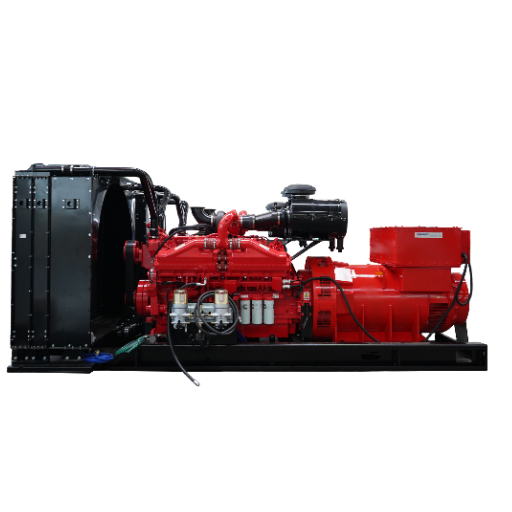
The engine and the alternator do different jobs, so they are rated in different units. The engine produces mechanical power, measured in kW. The alternator converts that into electrical power, and because it must carry the full current flowing through its windings, including reactive current that does no useful work, it is rated in kVA (apparent power).
The two are linked by power factor, almost always 0.8 for industrial sets. kW = kVA x 0.8, so a 500 kVA alternator delivers 400 kW of real power. This is the same relationship explained in full in our guide to generator kVA vs kW, and it is why a serious datasheet shows both numbers.
The alternator’s kVA rating is ultimately set by heat. The winding insulation can only run so hot before it ages prematurely, and that thermal limit, not the engine’s torque, is what caps the kVA figure. This is the key idea Stamford’s own overview makes, and everything else on the datasheet follows from it.
The Five Specifications That Actually Matter
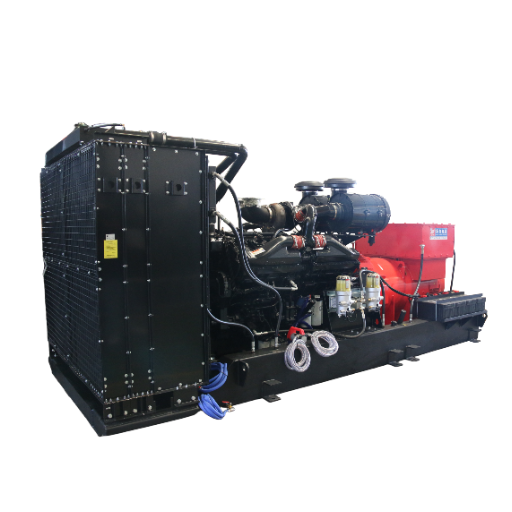
kVA Rating (50 Hz vs 60 Hz, Standby vs Prime)
The headline kVA is always stated at a frequency and a duty. The same alternator produces more at 60 Hz than at 50 Hz, because the faster speed moves more cooling air, so a unit rated 500 kVA at 50 Hz might carry 600 kVA at 60 Hz. It also carries more in standby duty (a few hundred hours a year) than in continuous duty, because the windings run hotter over 8,000 hours of continuous operation.
Always confirm the frequency and the duty before comparing two datasheets, or you will compare a 60 Hz standby figure against a 50 Hz prime figure as if they were equal.
Insulation Class vs Temperature Rise
This is where most readers get confused, because two different thermal numbers share one line. The insulation class (H, F, or B) is the maximum temperature the insulation can withstand over its design life: Class H is 180°C, Class F is 155°C, Class B is 130°C. The temperature rise is how much hotter the winding actually gets above ambient in service, typically 80°C (Class B), 105°C (Class F), or 125°C (Class H).
The smart spec is Class H insulation run at Class F rise. That leaves a 25°C safety buffer, which roughly doubles insulation life. Most low-voltage alternators are Class H; medium and high-voltage units are usually Class F.
| Class | Max Winding Temp | Typical Rise | Notes |
|---|---|---|---|
| B | 130°C | 80°C | Legacy, rare in new LV alternators |
| F | 155°C | 105°C | Standard for MV/HV |
| H | 180°C | 125°C | Standard for LV (<1 kV) |
IP Rating and Cooling Method
The IP rating tells you how well the enclosure resists dust and water. The first digit covers solids, the second covers liquids. IP23 is the standard ventilated alternator, open enough to cool itself but protected against fingers and light spray. IP44 and above means a sealed or heat-exchanger-cooled machine, and it costs output because the alternator can no longer breathe freely.
Going from IP23 to IP44 typically derates the output by 5-10%. So a 500 kVA IP23 machine might only be a 450 kVA machine in an IP44 enclosure. Spec the enclosure for the environment, then accept the smaller kVA, or you will buy a machine that overheats in the dust.
Not sure which enclosure and rise your site needs? Send us your site conditions and our engineers will specify the alternator to match, at no charge.
Subtransient Reactance (X”d)
Subtransient reactance is the spec nobody explains, and it is the one that most directly affects whether your set starts its motors. X”d is a measure of the alternator’s internal impedance in the first instant of a load change. A lower X”d means a smaller voltage dip when a large motor starts and a higher short-circuit current available to clear faults.
For low-voltage alternators, X”d is typically around 10-20% (0.10-0.20 per unit). The difference between a 12% and an 18% machine is real: at the same starting kVA, the lower-X”d alternator holds the voltage better. If your site has large motors, ask for this number and read it in the context of how motor starting kVA and voltage dip work.
Voltage Regulation and Short-Circuit Capability
Two more figures round out the electrical spec. Voltage regulation is how tightly the AVR holds the output, typically ±0.5% for a good AVR and up to ±1% for a basic one. Short-circuit capability is how much current the alternator can deliver into a fault, often 300% of rated current for about 10 seconds, which is what lets a downstream breaker trip and clear the fault instead of the whole system collapsing.
Excitation Systems: SHUNT vs AREP vs PMG
The excitation system decides where the AVR gets its power, and it is the quietest driver of price and behavior. There are three levels.
| Excitation | AVR Power Source | Short-Circuit | Motor Starting | Harmonics | Cost |
|---|---|---|---|---|---|
| SHUNT (self-excited) | Main stator output | Weak (may collapse) | Poor | Sensitive | Lowest |
| AREP (auxiliary winding) | Separate auxiliary winding | ~300% for 10 s | Strong | Good | Mid |
| PMG (permanent magnet) | Isolated magnet generator | Excellent | Strong | Immune | Highest |
SHUNT is the budget option. The AVR draws its power from the alternator’s own output terminals, so when a heavy load pulls the voltage down, the AVR’s supply sags too, and the whole thing can collapse. It is fine for simple standby with resistive loads, and wrong for motor-heavy or non-linear sites.
AREP adds a separate auxiliary winding to feed the AVR, so regulation holds even when the output dips. It is the workhorse for motor starting. PMG goes further, mounting a small permanent-magnet generator on the shaft so the AVR is completely isolated from the load, which makes it immune to the harmonics thrown by variable frequency drives and UPS systems.
Which Excitation You Need by Load Type
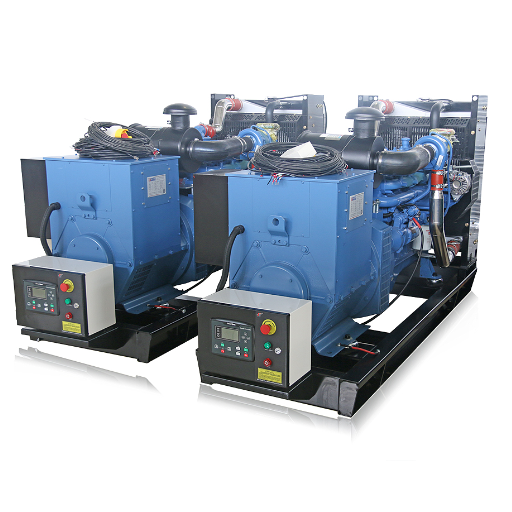
Match the excitation to your load. A small backup set feeding lights and heating can live with SHUNT. A pumping or crushing site with big motors wants AREP at minimum. A data center or cold-storage facility full of VFDs and UPS units needs PMG because the harmonics would otherwise distort the sensing signal the AVR depends on.
This is exactly the mistake Grace made: a VFD-heavy cold store on a SHUNT alternator, bought because it was cheaper, and offline the first time the compressors started.
Matching the Alternator to the Engine
The alternator and engine must be matched so that neither limits the other. The rule of thumb is that the alternator’s kVA should be the engine’s kW divided by the power factor: alternator kVA = engine kW / 0.8. In the other direction, an alternator can be oversized relative to the engine, but not undersized, or the engine never reaches its rated load.
A Worked Example: 400 kW Engine
A 400 kW engine at 0.8 power factor needs an alternator of 400 / 0.8 = 500 kVA. On the nameplate, that machine reads: 500 kVA / 400 kW, 400 V three-phase, 50 Hz, 0.8 power factor, Class H insulation at 125°C rise, IP23, X”d around 12%, PMG excitation with an MX321 AVR.
The rated current confirms it: 500,000 / (1.732 x 400) = 721 A, and your cables and breaker are sized for those 721 amps. If the same engine were matched to a 450 kVA alternator to save cost, it would run hot and age fast; matched to 500 kVA, it runs where it was designed to.
Stamford vs Leroy Somer vs Marathon
The alternator brand matters, but less than the excitation and specs you choose within it. Here is a fair, factual comparison of the three most common brands.
Stamford (Cummins) is the global default: the broadest familiarity, the easiest spare and AVR access, and predictable behavior across fleets and mixed commercial loads. It is a natural choice when you want standardization and easy diagnosis. Leroy-Somer (Nidec) is prized for strong voltage recovery and motor-starting transient response, and for holding up in heat, dust, and long-run duty. Marathon sits in between, common in North American standby applications.
The choice is less about one brand being better than about matching the load profile. A motor-heavy site benefits from whichever brand you spec with AREP or PMG and a low X”d; an electronics-heavy site benefits from PMG. The brand is the chassis, and the excitation is the engine of the decision.
AVR Matching (SX440, MX321, R450 and Friends)
Within each brand, the AVR model tells you the excitation level. Stamford uses SX460 for self-excited units, SX440/SX421 for mid-range, and MX341/MX321 for PMG machines with three-phase sensing. Leroy-Somer uses R438, R448, and R450 across its LSA range. The AVR and the excitation must match, or the alternator will not regulate.
How the Alternator Rating Maps to the Genset ISO 8528 Rating
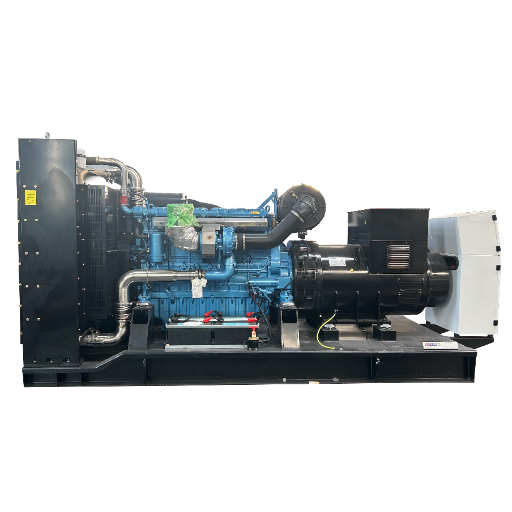
The alternator’s kVA is a component spec; the generating set’s rating is a system spec. The two connect through ISO 8528-1, which defines the set’s duty (ESP, PRP, LTP, or COP) in terms of run-time, load factor, and overload. The same 500 kVA alternator sits at the heart of a 500 kVA ESP set, a 455 kVA PRP set, or a 450 kVA COP set, depending on how the manufacturer de-rates the system for the duty.
This is why a datasheet should show the alternator spec and the genset rating together. For the full picture, read how the ISO 8528 ratings work and how to read a generator specification sheet field by field.
Frequently Asked Questions
What do the specs on an alternator mean?
An alternator spec sheet lists the kVA rating, voltage, frequency, phases, power factor, insulation class, temperature rise, IP rating, subtransient reactance (X”d), and excitation system. Each tells you how the machine will perform thermally, electrically, and under load.
What is insulation class H on a generator?
Insulation class H means the winding insulation can withstand up to 180°C over its design life. It is the standard for low-voltage alternators, and it is often run at a Class F temperature rise of 105°C to leave a thermal safety buffer.
What is the difference between SHUNT, AREP, and PMG excitation?
They differ in where the AVR gets its power. SHUNT draws from the main output and can collapse on heavy loads; AREP uses a separate auxiliary winding and handles motor starting; PMG uses an isolated permanent-magnet generator and is immune to harmonics.
What is X”d (subtransient reactance)?
Subtransient reactance is the alternator’s internal impedance in the first instant of a load change. A lower X”d means a smaller voltage dip when a large motor starts and more short-circuit current is available to clear faults.
What does IP23 mean on an alternator?
IP23 is the standard ventilated alternator enclosure, protected against fingers and light spray. Higher ratings like IP44 are sealed and resist dust and water, but they cost roughly 5-10% of the output rating.
Why is the alternator rated in kVA and the engine in kW?
The engine produces mechanical power in kW, while the alternator carries apparent power in kVA, including reactive current that does no useful work. The two are linked by power factor: kW = kVA x 0.8.
Conclusion: Read the Five Specs, Match the Pair, Pick the Excitation
Generator alternator specifications come down to five numbers and one decision. The kVA rating sets the thermal ceiling, the insulation class and temperature rise set the life, the IP rating sets the environment, X”d sets the motor-starting behavior, and the excitation system sets how the machine holds up under load. Match the alternator to the engine with kVA = kW / 0.8, and pick SHUNT, AREP, or PMG for your load profile.
Do that, and you will never be the buyer who learns on commissioning day that a “500 kVA” set was the wrong 500 kVA. If you would rather have an engineer make the call, that is what we do every day. Shandong Huali Electromechanical builds generator sets from 8 kVA to 4000 kVA, pairing Cummins, Perkins, Weichai, and Yuchai engines with Stamford alternators, with every unit matched and tested before delivery.
