
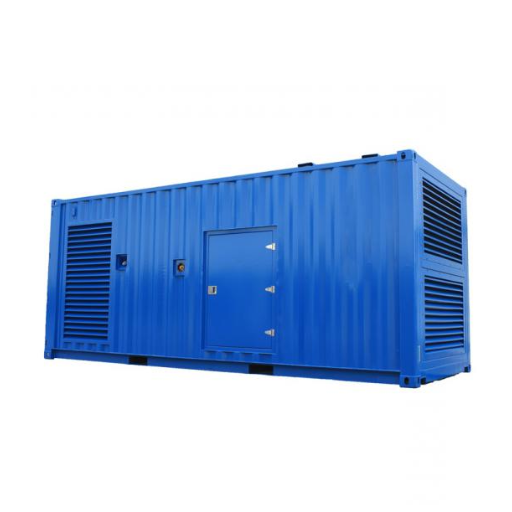
A containerized generator includes an entire power generation system packaged in a regulation-length ISO shipping container; the engines, alternators, fuel tank, cooling system, and controls are all packaged into one portable, weatherproof structure. These units are small, strong, and easy to handle. They can be kept within 20-foot containers, with sizes of 200 kVA and about 40-foot high-cube containers with 3,000-plus kVA. These multiple units can be poised at modulate-controlled power plants to a capacity of exceeding 10 MW.
That is exactly what a project engineer comes to terms with much too late – traditional power infrastructure takes six to twelve months of civil construction, permitting, and on-site assembly. A containerized generator will arrive on a semi-trailer, fast connect to your fuel and electrical connections, and yield full 100% load after 48 hours of delivery.
It is not an incremental but a transformationary change.
Following is the full technical and commercial layout for plant computer selecting, installation, and operation. Topics include the 20-ft and 40-ft dimensions, paralleling architecture for multi MW plants, noise reduction technology, and certification requirements, true cost data for kW size, as well as additional features mainly required for mining and coastal facilities. By the end, you will acquire a procurement specification that will wrap up several other months from your project timeline.
Key Takeaways
- Containerized generators integrate engine, alternator, fuel, and controls into ISO-standard 20ft or 40ft shipping containers for rapid global deployment.
- Single units range from 200 kVA to 3,000+ kVA; paralleled systems scale to 10+ MW with automatic synchronization and load sharing.
- Noise levels range from 65 dB(A) for super-silent models to 85 dB(A) for industrial grades, measured at 7 meters per ISO 3744.
- CSC certification and ISO 1496-1 compliance are mandatory for international shipping; ISO 8528 defines electrical performance classes G1 through G4.
- Total cost of ownership often favors containerized units for outdoor or remote sites because avoided civil works and soundproofing offset higher purchase prices.
What Is a Containerized Generator?
Definition and Core Concept
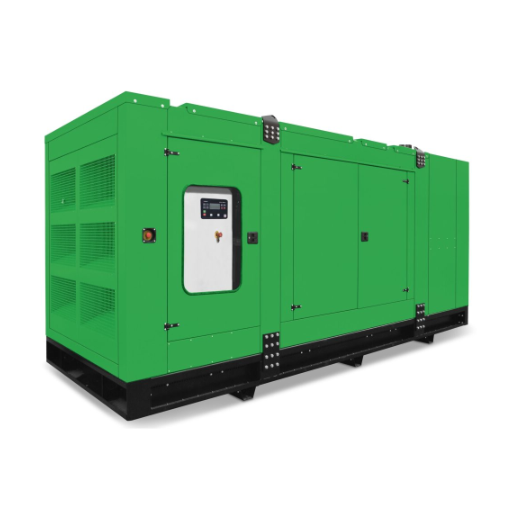
A containerized genset is a modular power generating unit, provided with assembly at the factory within a standardized and available (rented or purchased) ISO ship container. In contrast, traditional open-genset or canopy generators come mounted on a mild-steel frame or on some enclosure made to house aluminum plates. The containerized approach utilizes the container for the enclosure itself, with the container walls being reinforced and internally covered with fireproof acoustic insulation, engineered ventilation louvers, and an exhaust silencer, including maintenance access panel.
Thus, we get a powerhouse covering the components within from rainwater, dust, salt-air, and harsh temperatures, while substantially reducing the noise levels to match urban and residential requirements. Further, as the dimensions meet the ISO standards, it can be lifted by standard crane devices, carted on standard trucks, and be shipped internationally without the need for any special handling equipment.
ISO Container Standards: 20ft vs 40ft
Container size scales directly with power rating. The industry follows a predictable pattern.
| Power Range | Container Size | Typical Dimensions (L x W x H) |
|---|---|---|
| 200-1,000 kVA | 20-foot ISO / 20HC | 6,058 x 2,438 x 2,591 mm |
| 1,000-1,250 kVA | 20-foot HC or 30-foot custom | 6,058-9,125 x 2,438 x 2,896 mm |
| 1,250-2,500 kVA | 40-foot ISO / 40HC / 40HQ | 12,192 x 2,438 x 2,896 mm |
| 2,500-3,500 kVA | 40-foot high-cube or custom extended | 12,192+ x 2,500 x 2,896+ mm |
The 20ft container generator dominates the 200-1,000 kVA market. It offers sufficient internal volume for the engine-alternator package, an integrated daily fuel tank of 500-1,000 liters, and the acoustic and ventilation systems required for silent operation. The 40ft container generator handles larger engines and provides space for auxiliary equipment such as step-up transformers, paralleling switchgear, and extended fuel tanks.
What Is Inside: Engine, Alternator, Fuel, Controls, Cooling
Every containerized generator set contains the same core systems, pre-wired and factory-tested before shipment.
Engine: Diesel engines from Cummins, Perkins, MTU, Weichai, or Yuchai typically power these units. Engine selection depends on duty cycle, fuel availability, and emission requirements. This makes the containerized diesel generator the most common configuration for industrial prime power. Prime power applications favor heavy-duty blocks with longer service intervals.
Alternator: Stamford, Leroy-Somer, or Marathon alternators with IP23 protection and Class H insulation are standard. Automatic voltage regulation (AVR) maintains output within tight tolerances.
Fuel System: An integrated daily fuel tank sits inside the container base, with capacity for 24 to 72 hours of operation at full load. External fuel connections allow tying into larger bulk storage tanks.
Control System: Digital auto-start controllers from ComAp, Deep Sea, or Woodward manage engine starting, monitoring, and protection. Remote monitoring via SCADA or cellular telemetry is standard on modern units. For a deeper look at how to evaluate engine brands, alternator quality, and control systems across all generator types, see our diesel generator set buyer’s guide.
Cooling System: Radiator cooling with thermostatically controlled motorized louvers manages airflow. The container roof or side panels incorporate exhaust fans that activate based on internal temperature.
The requirement for set kind of emergency power was put forth by a project team on a Kazakhstan-based oilfield situated in a remote area without any grid support; so they went with four 1,000 kW containerized gaseous generator banks. The units were delivered presentable and synchronized within 48 hours and produced an output voltage of 6.3 kV using an integrated step-up transformer. The traditional stick-built way of doing it would have been at least a six-month job built within a rigid structure. However, in this containerized situation, the whole setup took less than one week to be fully installed.
Container Generator vs Open Generator: Which Enclosure Do You Need?
Side-by-Side Comparison
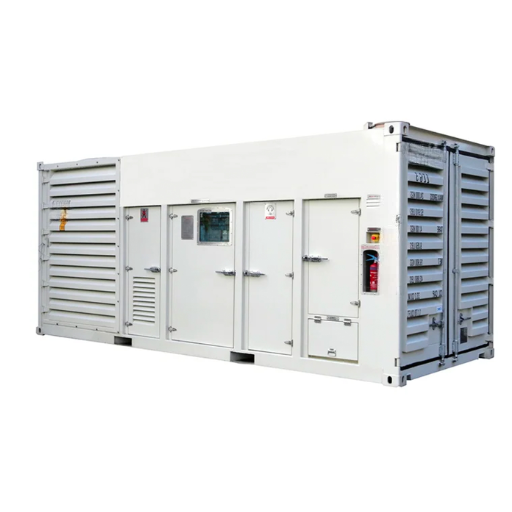
Choosing between generator enclosure types is not a question of preference. It is a question of site conditions, logistics, and lifecycle economics.
| Feature | Open (Skid-Mounted) | Canopy (Silent) | Containerized |
|---|---|---|---|
| Enclosure | None | Purpose-built sheet metal cover | ISO-standard steel container |
| Noise @ 7m | 85-110 dB(A) | 70-80 dB(A) | 65-85 dB(A) |
| Weather Protection | None | Moderate | Full (rain, dust, salt) |
| Power Range | Any kVA | Usually up to 800 kVA | 200 kVA to 3,500+ kVA |
| Portability | Low | Moderate | High (global logistics) |
| Security | None | Moderate | High (lockable, robust) |
| Setup Time | Months (building required) | Weeks | Days |
| Civil Works | Extensive (generator room) | Moderate (pad + shelter) | Minimal (level hardstanding) |
| Upfront Cost | Lowest | Moderate | Highest |
| Typical Application | Permanent indoor installation | Outdoor urban/suburban | Remote, mobile, harsh environments |
Open-type generators are the economical choice when your facility already has a protected generator room with proper ventilation and noise isolation. The exposed design gives maintenance technicians unrestricted access to every component. Canopy generators split the difference, offering weather protection and moderate noise reduction for outdoor installations where full container logistics are unnecessary. If your primary concern is noise compliance rather than shipping or weatherproofing, our silent diesel generator guide explains when canopy units are the better choice.
Containerized generators dominate when any of the following conditions apply: the site lacks permanent structures, the project requires international shipping, the environment is harsh, noise regulations are strict, or the power demand may scale over time.
When to Choose Containerized
Select a containerized generator set when your project matches one or more of these profiles.
- Remote or off-grid sites without existing buildings, such as mining camps, construction fronts, or telecom towers
- Temporary or mobile operations where the generator must relocate between projects
- Export or international projects requiring standard shipping formats and CSC certification
- Coastal or marine environments where salt air corrosion destroys exposed equipment
- High-dust locations such as deserts, quarries, or unpaved construction zones
- Noise-sensitive areas with strict dB(A) limits, including residential zones and hospitals
- Scalable power needs where capacity may grow from 1 MW to 5 MW over several years
When Open-Type or Canopy Is Better
For fixed indoor installations, open-frame generators seem like a suitable choice within environment which is already controlled. Generators running in a manufacturing plant may not require these extra layers of protection that a generator in a container can offer, which means that the primary role would generally involve sufficient noise suppression and environmental protection. Placing a generator in a container would be a fairly redundant extra that also would limit access for maintenance.
Canopy generator sets are more suitable for outdoor installations near occupied structures considering the concern for noise while eschewing worries normally associated with shipping overseas and harsh weather conditions. They are cheaper than enclosed units and have easy access to maintenance in comparison with full containers.
Want to compare power capacities for your specific load? Use our kVA to kW calculator to verify generator sizing before selecting an enclosure type.
Key Advantages of Containerized Generator Sets
Rapid Deployment and Plug-and-Play Installation
Containerized power modules shift the construction paradigm from on-site assembly to factory integration. The engine, alternator, exhaust, cooling, fuel, and control systems are installed, wired, and tested in a controlled manufacturing environment. Factory Acceptance Testing (FAT) verifies every parameter before the unit ships.
On site, the workflow is simple. Position the container on a level hardstanding pad. Connect the fuel inlet, exhaust outlet, and power cables.
Start the engine. For a 1,000 kVA unit, this process takes hours, not months.
Modular data center studies confirm that prefabricated power and cooling modules deploy at least 60 percent faster than traditional infrastructure, with first-cost savings of 13 percent or more.
Weatherproofing and Security
The container structure is built from Cor-Ten or galvanized steel, typically 2 mm thick, with fully welded seams and marine-grade coatings. This enclosure achieves IP55+ equivalent protection against dust and water ingress. Lockable doors with panic bars prevent unauthorized access. In regions with high theft risk, the container is a vault that happens to generate power.
Transport Logistics
CSC certification (Convention for Safe Containers) means the generator can be stacked on container ships, lifted by standard spreaders, and secured to standard chassis. No special permits. No oversized load escorts. No custom cradles.
This single certification eliminates the logistics complexity that kills international project timelines.
Technical Specifications and Design Features
Power Ranges and Container Sizing
Manufacturers align container dimensions with power ratings to optimize acoustic performance, fuel capacity, and service access.
| Power Rating | Container | Noise Level @ 7m | Fuel Tank |
|---|---|---|---|
| 200-500 kVA | 20-foot | 70-75 dB(A) | 500-800 L |
| 500-1,000 kVA | 20-foot HC | 72-78 dB(A) | 800-1,200 L |
| 1,000-1,500 kVA | 40-foot | 75-80 dB(A) | 1,500-2,000 L |
| 1,500-2,500 kVA | 40-foot HC/HQ | 78-82 dB(A) | 2,000-3,000 L |
| 2,500-3,500 kVA | Custom 40-foot+ | 80-85 dB(A) | 3,000-5,000 L |
Silent Container Generator: Soundproofing Engineering
Noise attenuation relies on a multi-layer system. Interior walls and ceilings are lined with fireproof, flame-retardant acoustic panels backed by multi-frequency PUR sound-absorbing cotton. High-frequency noise from turbochargers is absorbed by perforated metal baffles.
Low-frequency exhaust rumble passes through industrial-grade mufflers and ripple-flex exhaust pipes. The result is a generator that produces less noise at 7 meters than a normal conversation at 1 meter.
Cooling and Ventilation
Thermostatically controlled motorized louvers open when the engine runs and seal when it stops, preventing dust ingress during shutdown. Axial exhaust fans maintain positive airflow through the engine compartment. Air enters through filtered intake louvers, passes over the engine and alternator, and exits through the radiator and roof vents. In tropical climates, auxiliary ventilation fans supplement the standard system.
Building Modular Power Plants: Paralleling Containerized Generators
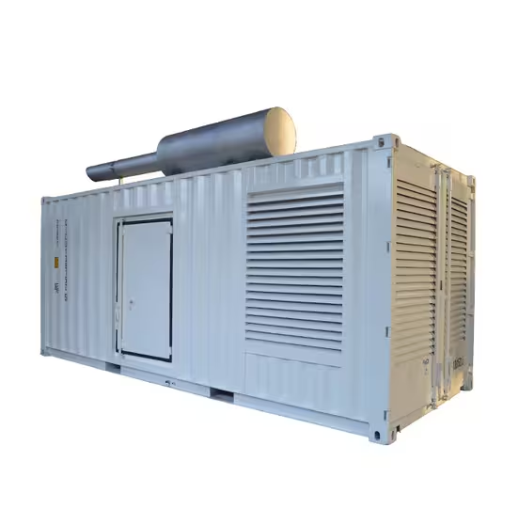
This is the most underexplored advantage of containerized generator architecture. A single container delivers megawatts. Multiple containers deliver a containerized power plant.
How Synchronization Works
Paralleling generator sets requires matching four parameters before the breaker closes: voltage magnitude, frequency, phase angle, and phase sequence. Modern automatic synchronizers from ComAp, Woodward, and DEIF track these parameters continuously. They calculate an advance angle that triggers breaker closure slightly before perfect alignment, compensating for mechanical contact delay so the generator connects to the bus at zero phase difference.
Once synchronized, integrated power management systems handle load sharing. In isochronous mode, all units maintain exactly 50 or 60 Hz while splitting real power (kW) proportionally. In droop mode, slight frequency variation allows stable load distribution without constant governor adjustment. Reactive power (kVAR) sharing is managed through the AVR excitation system.
Real-World MW-Scale Deployments
Containerized paralleling is not theoretical. These configurations are operating now.
| Project | Capacity | Configuration | Voltage |
|---|---|---|---|
| Kazakhstan Oilfield | 4 MW | 4 x 1,000 kW gas gensets | 6.3 kV |
| Peru Oilfield | 6 MW | 6 x 1,200 kW gas gensets | 13.8 kV |
| Latin America Stadium | 9.6 MW | 6 x 1,610 kVA diesel gensets | 13.8 kV |
| Africa Power Systems | 2.4 MW | 2 x 1,200 kW diesel gensets | 400 V |
The Latin America stadium project is particularly instructive. Six 1,610 kVA containerized diesel generators feed medium-voltage switchgear through step-up transformers. The system provides N+1 redundancy for broadcast power, lighting, and safety systems. If one container fails, the remaining five automatically assume the full load without manual intervention.
When Sara Okafor took over operations at a West African telecom network, she inherited 47 cell towers powered by individual open-frame generators. Theft, weather damage, and fuel contamination caused an average of 12 hours downtime per tower per month. Sara replaced the scattered units with 2.4 MW of containerized capacity at three hub sites, each feeding multiple towers through distribution lines.
Dropped to 0.3 hours per month. The containerized units paid for themselves in 18 months through fuel security, theft prevention, and eliminated emergency repairs.
N+1 Redundancy and Load Sharing
Modular containerized plants make redundancy economically practical. Instead of building one massive 5 MW generator with a standby spare, you install six 1,000 kW containers in an N+1 configuration.
Normal operation runs five units at 80 percent load. If any unit fails, the remaining five absorb the full load at 96 percent capacity. Maintenance cycles become non-events because you service one container while the others carry the load.
Containerized Generator Applications by Industry
Mining and Remote Construction
Mining operations require prime power in locations without grid access, paved roads, or permanent buildings. Containerized generators provide the durability and logistics simplicity these sites demand.
Dust filtration systems with pre-cleaners extend air filter life. Double-wall fuel tanks prevent ground contamination. High-capacity base tanks reduce refueling frequency in areas where diesel delivery is unreliable. For more on how industrial diesel generators are specified for mining, manufacturing, and heavy construction, see our overview of industrial diesel generator applications.
Data Centers and Critical Infrastructure
Data center operators increasingly specify containerized generator sets for rapid capacity expansion. When cloud demand surges, a data center can add 2 MW of backup power by installing two 40-foot containers and synchronizing them with existing infrastructure.
No construction permits, no building extensions, no disruption to live IT load. For data center-specific design requirements, see our generator for data center guide. For a broader view of how backup power systems are designed and specified, see our complete backup power generator guide.
Telecom and Off-Grid Base Stations
This is necessary to ensure that an unmanned telecom tower can function with a reliable power source, reducing the number of visits to the site. A station in a container is self-sufficient with a 72-hour fuel tank and remote telemetry, operating for multiple weeks at a time without any human intervention so as to be resourceful to guard off diesel theft.
Events, Military, and Disaster Relief
Temporary power for concerts, expos, or emergency response should reach fast and work right away. Containerized gensets are shipped as regular cargo, clear customs without any special papers, and will start power production within some hours after unloading. Military applications should have camouflage paint, EMI shield in, and kit for air transport.
Certifications and Standards for Containerized Generators
ISO 8528 Performance Classes
The ratings of the generator package are defined underneath ISO 8528-1: Prime Power (unlimited hours, 10 percent overload allowed), Standby Power (emergency use only, no overload), and Continuous Power (constant load, unlimited hours). The Performance Class of G1 through G4 based on voltage and frequency stability is defined underneath ISO 8528-5. G3 is the target performance class for most industrial containerized generators suitable for data centers, hospitals, and industrial loads. G4 applies to the most sensitive loads, including certain semiconductor manufacturing processes.
CSC and ISO 1496-1 Container Safety
The container itself must carry a valid CSC Safety Approval Plate to be transported internationally. This certifies that the enclosure meets structural requirements for stacking, racking, and lifting.
ISO 1496-1 specifies the dimensional and strength standards. Corner castings must withstand the loads imposed by standard spreaders. Floor strength must support the wet weight of the generator without deformation.
Emissions and Regional Compliance
- EPA Tier 4 Final (United States): Mandates ultra-low particulate and NOx emissions
- EU Stage V (Europe): Equivalent stringent standard for non-road engines
- CE Marking (European Economic Area): Confirms compliance with machinery, EMC, and low-voltage directives
- China Stage IV/V: Progressive emission standards for domestic and export units
Marine and offshore applications may require additional classification society approvals from DNV, ABS, or CCS. These certify structural integrity, fire safety, and electrical system suitability for shipboard or platform installation.
Containerized Generator Price Guide by kW Size
Most manufacturers avoid publishing prices because engine brand, soundproofing grade, and control system selection create wide variation. But procurement teams need budgetary numbers. Here is what a containerized diesel generator costs in 2026.
| Power Rating | Engine Tier | Approximate Price Range (USD) | Typical Lead Time |
|---|---|---|---|
| 200-500 kVA | Chinese brand (Weichai/Yuchai) | $25,000-55,000 | 4-6 weeks |
| 200-500 kVA | Premium brand (Cummins/Perkins) | $45,000-85,000 | 6-10 weeks |
| 500-1,000 kVA | Chinese brand | $55,000-110,000 | 4-8 weeks |
| 500-1,000 kVA | Premium brand | $95,000-180,000 | 8-12 weeks |
| 1,000-1,500 kVA | Chinese brand | $110,000-180,000 | 6-10 weeks |
| 1,000-1,500 kVA | Premium brand | $180,000-320,000 | 10-14 weeks |
| 1,500-2,500 kVA | Premium brand (MTU/Cummins) | $280,000-550,000 | 12-16 weeks |
| 2,500-3,500 kVA | Premium brand | $500,000-900,000 | 14-20 weeks |
These figures include the container enclosure, base fuel tank, standard silencer, digital control panel, and automatic voltage regulator. Options that add cost include super-silent attenuation (add 15-25 percent), high-voltage step-up transformers (add 10-20 percent), extended fuel tanks (add 5-15 percent), and advanced paralleling controls (add 8-12 percent).
Total Cost of Ownership
The purchase price is only part of the equation. Open-type generators require a generator room, concrete foundation, exhaust ducting, fuel storage, and noise barrier walls. These civil works typically add 30-50 percent to the total project cost.
Containerized generators need only a level hardstanding pad and electrical connection. For remote or temporary sites, the avoided construction cost often makes the containerized unit the lower total-cost option despite its higher purchase price.
Need a precise quote for your project? Contact our engineering team for a customized containerized generator specification and pricing based on your power requirements, site conditions, and delivery timeline.
How to Choose the Right Containerized Generator
Power Requirement Calculation
Start with your total simultaneous load in kW or kVA. Add the highest motor starting current in your system. Apply a 1.25 safety factor for future expansion.
The result is your minimum generator capacity. Never size a standby generator below 125 percent of expected full load. For a detailed walkthrough of load calculation, motor starting surge, and environmental derating, see our industrial generator sizing guide.
Prime vs Standby Duty Cycle
Prime power applications run the engine continuously and require heavy-duty blocks with longer service intervals and larger cooling systems. Standby applications run only during grid outages and can use lighter-duty engines with shorter maintenance intervals. The wrong duty rating will destroy the engine through premature wear.
Site Conditions and Environmental Factors
High altitude reduces engine output by approximately 1 percent per 100 meters above 1,000 meters. High temperature reduces output by approximately 2 percent per 10 degrees Celsius above 25 degrees Celsius. Dusty environments need enhanced air filtration with cyclone pre-cleaners. Coastal sites need stainless steel hardware and epoxy coatings to prevent salt corrosion.
Supplier Evaluation Checklist
- Does the manufacturer hold ISO 9001 certification?
- Are alternators from recognized brands (Stamford, Leroy-Somer, Marathon)?
- Is the container CSC-certified for international shipping?
- Does the control system support remote monitoring and paralleling?
- What is the warranty period and local service network coverage?
- Can the manufacturer provide Factory Acceptance Testing documentation?
At Shandong Huali Electromechanical, we manufacture containerized diesel generator sets from 8 kVA to 4,000 kVA with Cummins, Perkins, Weichai, and Yuchai engines. Every unit undergoes 100 percent load testing in our national standard testing center before shipment. Our engineering team supports customization for tropical, arctic, high-dust, and marine environments.
Maintenance Considerations for Containerized Units
Access Constraints and Service Door Design
The enclosed design restricts workspace compared to open-frame units. Quality containerized generator designs address this with wide side doors, removable roof panels, and internal LED lighting. Specify a unit with service doors on both sides if your maintenance protocol requires frequent filter and belt changes.
Ventilation Filter Maintenance
Air intake filters protect the engine compartment from dust but clog faster in dusty environments. In desert or mining applications, inspect intake filters weekly. Clean or replace them before restriction indicators activate. A clogged intake filter reduces engine output and increases exhaust temperature.
Corrosion Protection
Coastal and tropical humidity accelerates corrosion on steel containers. Specify marine-grade polyurethane paint, stainless steel hinges and locks, and galvanic isolation between dissimilar metals. Inspect the container exterior annually for paint degradation and touch up any bare metal immediately.
Load Bank Testing
Containerized generators in standby service must be load bank tested regularly to prevent wet stacking. The enclosed environment makes portable load bank connection slightly more complex because exhaust heat must be vented safely. Specify external exhaust extension ports if your facility conducts frequent load bank testing. For detailed maintenance protocols, refer to our diesel generator maintenance guide.
Special Configurations and Custom Options
High-Voltage Output
A standard containerized generator produces 400 V or 480 V. For utility-scale or large industrial applications, manufacturers integrate step-up transformers inside the container or in an adjacent transformer container. Common output voltages include 6.3 kV, 10.5 kV, and 13.8 kV. This eliminates the need for external switchgear buildings.
Hybrid Containers: Generator + BESS + Solar
The latest evolution combines diesel generators with battery energy storage systems (BESS) and solar charge controllers inside a single 40-foot container. The batteries handle peak loads and absorb renewable generation. The diesel engine runs at optimal efficiency to charge batteries, reducing fuel consumption by 30-50 percent compared to direct diesel-only operation.
Double-Stack Fuel Systems
For sites with unreliable fuel logistics, manufacturers offer double-stack base tanks that increase autonomy from 48 hours to 7-10 days. These systems include automatic fuel transfer pumps, level monitoring, and leak detection sensors.
Arctic and Tropical Packages
Arctic packages add engine block heaters, insulated coolant lines, and cold-start batteries rated to minus 40 degrees Celsius. Tropical packages upgrade cooling systems, add tropical-rated alternators with enhanced moisture protection, and specify higher-capacity air filtration.
Conclusion
Containerized generators have changed the power infrastructure from a civil construction project to a logistics one. To transport a fully tested megawatt-class power plant in a standard container, cradle it off the truck, up quickly produce a plug-and-play power plant delivering 10 MWs is unheard of and henceforth changes the economics of remote power, data center expansion, and emergency backup.
When the total cost of ownership is considered, the rationalization of the purchasing decision is simple. For permanent indoor installations with existing generator rooms, open type units still make sense. For every other contingency, such as remote sites, harsh environments, mobile operations, international projects, noise-sensitive locations, and scalable power needs, containerized generators have the least lifecycle costs, fastest deployment, and best security.
Let us look at the framework of the specs given in this book. Assess your load properly. Choose the right container format for your power ratings.
You must take into account the code stack that is asked for in the area. Prepare for parallelization if your initial requirement expands to 18 units.
Bear in mind that frequently a 300,000-containerized-generator-in-place-in-two-weeks-outperforms-a-300,000-containerized-generator-in-place-in-two-weeks-outperforms-a-200,000 open frame unit that took six months to become operational.
Ready to specify your containerized generator? Contact our engineering team for a customized power solution tailored to your capacity requirements, site conditions, and deployment timeline.
Containerized Generator FAQ
What is a containerized generator?
A containerized generator is a complete power generation system built inside a modified ISO shipping container. It integrates the engine, alternator, fuel tank, cooling system, exhaust silencer, and digital controls into a single transportable, weatherproof, and often soundproof unit that can be shipped and deployed rapidly.
How much does a containerized generator cost?
Prices range from approximately 25,000−85,000for200−500kVAunits,25,000−85,000for200−500kVAunits,55,000-320,000 for 500-1,500 kVA units, and $280,000-900,000 for 1,500-3,500 kVA units depending on engine brand, soundproofing grade, and options. Super-silent attenuation, high-voltage transformers, and paralleling controls add 8-25 percent.
Can containerized generators run in parallel?
Yes, multiple containerized gasifiers can be synchronized to-each if modular power plants exceeding 10 MW. The automatic synchronizer equalizes phase angle, voltage, and the frequency of generators before connecting them to a common bus system. After paralleling the generators, power sharing systems are used to determine output sharing of real and reactive power between all connected units.
What is the noise level of a containerized generator?
Standard containerized generators produce 75-80 dB(A) at 7 meters. Super-silent models with enhanced acoustic insulation achieve 65-72 dB(A). Industrial grades without extensive soundproofing may reach 80-85 dB(A). All measurements follow ISO 3744 at 100 percent rated load.
What container sizes are used for generators?
200-1,000 kVA units typically use 20-foot ISO containers. 1,000-2,500 kVA units use 40-foot ISO or high-cube containers. Units above 2,500 kVA may use extended or custom-length containers. CSC certification is required for international shipping of all containerized generator sets.
Are containerized generators weatherproof?
Yes, the enclosure with sealed seams of steel and marine-grade coatings is also provided with a full armored shield from rain, dust, salt in air, and any temperature extreme. The shaded room has a rated equivalent of IP55 or above when it comes to dust/water ingress.
What certifications should a containerized generator have?
Qualifications can come from ISO 8528 for electric energy generation, CSC and ISO 1496-1 for cargo containers and trustworthy provision of containers in international transport, CE certification for acceptance into the European market, and emission compliances to EPA Tier 4 Final or EU Stage V. For marine applications, DNV, ABS, or CCS classes may also be required.