
A generator cooling fan does one job: pull air through the radiator core so the coolant inside can give up its heat. Everything about the part follows from that. The blade shape decides how much air moves, the drive decides whether the blade turns at the right speed, and the shroud decides whether the air goes through the core or around it.
The failure is rarely dramatic. A fan blade cracks, a belt glazes, a pulley sits a few millimetres out of line. None of it stops the engine. All of it quietly removes cooling capacity that you only miss on the hottest day at full load.
This page covers the fan and its drive as a component: the two fan types and how to tell them apart, the belt and pulley faults that cost airflow, blade damage and balance, and the checks worth doing at each service. For the wider circuit, our guide to the generator cooling system covers the pump, thermostat and coolant.
Key Takeaways
- A generator cooling fan moves air across the radiator core; it does not cool the engine directly, so any airflow loss shows up as a coolant temperature rise under load.
- Fans come in two orientations, suction and blower, and telling them apart matters because a fan fitted the wrong way round still turns, still makes noise, and still undercools.
- Pulley alignment is the most overlooked belt fault. A belt that runs true but slightly out of line wears on one edge and fails early, long before tension looks wrong.
- A bent blade is a balance problem, not an airflow problem. Straightening a blade does not restore balance, and an out-of-balance fan loads the bearing and water pump.
- Belt tension and bearing play are already covered on our generator radiator page. This article does not repeat them.
What a Generator Cooling Fan Actually Does
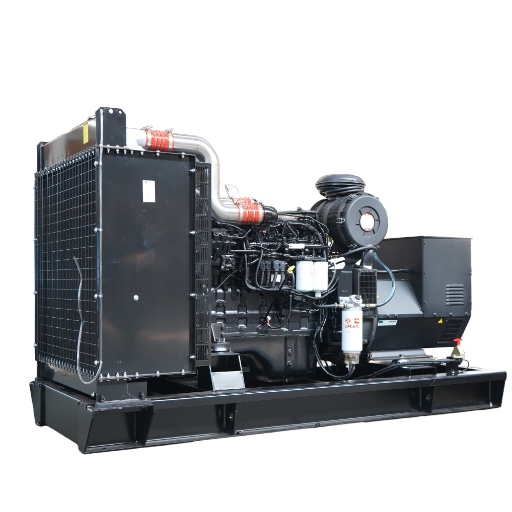
The fan sits behind or in front of the radiator core and moves air through it. That is the whole function, and it is worth stating plainly because it explains every failure mode that follows.
Heat leaves the engine in the coolant, the coolant carries it to the radiator, and the radiator gives it to the air. The core does that transfer. But a core with no air moving through it transfers almost nothing, however clean and well-sized it is.
This is why fan faults present as temperature problems rather than as obvious mechanical failures. The engine runs normally at light load, when the heat rejection is small. Then load climbs, heat rejection climbs, and the airflow that was adequate at 30% is not adequate at 80%.
Why airflow failures hide at light load
A standby set that only ever runs at low load can carry a degraded fan for years without anyone noticing. The set starts, it takes the load, the temperature gauge sits where it always sits, and everybody assumes the cooling system is fine.
Then the set runs a full-load test, or a real outage coincides with a hot afternoon, and the temperature climbs. The radiator gets blamed. The coolant gets changed, then the thermostat gets replaced.
The fan is the last thing anyone checks, because it is visibly turning.
If your set only overheats under load and runs cool at idle, treat airflow as a suspect before touching the coolant circuit. Our generator overheating guide walks through the full symptom tree, and it is the right place to start if you are not yet sure the fan is involved.
Suction or Blower: Getting the Fan Type Right
Generator fans come in two orientations, and the difference is which way the air is pushed relative to the radiator core.
A suction fan draws air through the core from the outside and discharges it toward the engine. A blower fan pushes air through the core from the engine side and discharges it outward. Both are common, and both are correct in the right installation. The suction fan vs blower fan choice is settled by the installation, not by preference.
Reading the blade orientation
The blade is the giveaway. Diesel Generator Tech describes the test: the concave face of the blade is the pressure face, the side that does the work.
Look at the fan from the front of the engine. If the concave face points toward you, it is a blower. If the convex face points toward you, it is a suction fan.
That is a physical check you can do in a minute with the set stopped and the guard off, and it settles the question without a parts catalogue.
What happens when a fan is fitted backwards
A reversed fan still turns. It still moves air. It just moves less of it, in a less useful direction, and the engine runs hotter than the design intended.
This is a real failure mode after a rebuild or a blade replacement, because the part physically fits either way. Diesel Generator Tech warns about exactly this: fit a fan in reverse and the non-pressure face becomes the pressure face, airflow drops, and radiator performance falls with it.
The symptom is a set that cooled correctly before a repair and does not cool correctly after it. If that timing lines up, check the fan orientation before you check anything else.
Specifying or rebuilding a set and want the fan drive confirmed against the duty cycle? Our engineers review the cooling package against the load profile and the ambient conditions the set will actually see. Talk to our engineering team →
The Generator Cooling Fan Drive: Belt, Pulley and Bearing
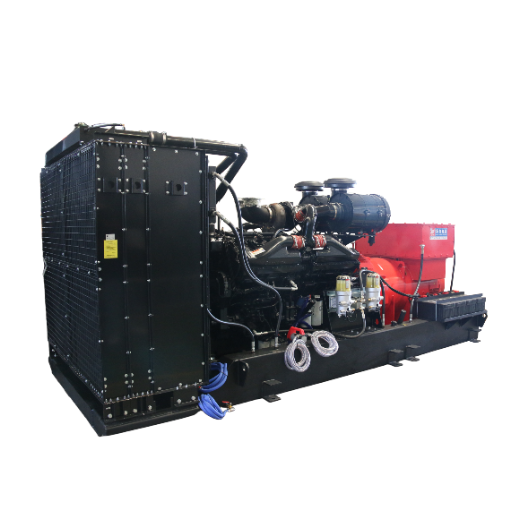
Most generator fans are belt-driven from the engine. The arrangement varies by set, and WingFan’s breakdown of genset cooling layouts is a useful map: on a radiator mounted directly to the engine, the fan is mechanically driven through the belt system or a gearbox with a ratio the engine manufacturer specifies. On a cooler with a mechanically guided fan, the ratio is set by choosing the fan pulley, the belt and the fan speed together.
That second point matters more than it looks. Fan speed is a design choice, not a fixed consequence of engine speed. Change the pulley and you change the airflow, the parasitic load the fan puts on the engine, and the noise.
On larger and more heavily loaded installations, the drive itself may not be a plain fixed belt. Horton catalogues fan drives as variable-speed, two-speed or on/off, and the last of those lets the fan be disengaged when cooling demand is low. A genset fan drive is usually simpler than that, but the principle is the same: the drive decides when and how fast the fan turns.
Pulley alignment
Alignment is the belt fault that gets missed because it does not announce itself. A misaligned pulley does not squeal the way a loose belt does. It wears the belt on one edge, and the belt fails earlier than its service life should allow.
Read the generator fan belt itself for the diagnosis:
| What the belt shows | What it usually means |
|---|---|
| Wear along one edge only | Pulleys out of alignment |
| Glazed, shiny surface | Slipping, from low tension or a worn belt |
| Cracks across the ribs | Age, or heat and ozone exposure |
| Frayed or missing ribs | A pulley or tensioner problem, not just belt wear |
Edge wear is the alignment signature. If you replace a belt and the new one wears the same way, the belt was never the problem.
The practical check is a straight edge across the pulley faces, with the belt removed. All the pulleys in the drive should sit in the same plane. Any offset, however small, will wear the belt.
Pulley alignment is worth checking even when the belt looks healthy, because it is the one fault on this page that can be present from the day a set was built. A drive assembled with the fan pulley set slightly forward of the crank pulley will run for months before the edge wear becomes visible, and by then the first belt is already scrap.
Belt tension and bearing play
Tension and bearing condition are covered on our generator radiator page, and there is no value in repeating them here. The short version: a glazed or slack belt slips under load, airflow falls, and the radiator stops performing exactly when the engine needs it most.
What that page does not cover is the relationship between the two. An over-tight belt is as damaging as a loose one, in a different way. Too tight and you load the fan bearing and the water pump bearing beyond their design. The belt survives; the bearings do not.
Bearing failure and the noise before it
A fan bearing rarely fails without warning. It rumbles, then whines, then seizes, and the interval between the first two is usually long enough to act on.
Listen with the set running and the guard in place, then again with the set stopped and the belt off. Spin the fan by hand. It should turn smoothly with light resistance and no lateral play. Roughness, grinding, or movement you can feel at the hub means the bearing is on its way out.
Do not wait for the noise to become obvious. A seized fan bearing at full load takes the belt with it, and on some engines the same belt drives the water pump.
Fan Blade Damage and Balance
A generator fan blade gets damaged in service in a handful of ways: a stone through the guard, a careless knock during maintenance, corrosion along a leading edge, or fatigue cracking at the root.
Why a bent blade is a balance problem
A fan is a rotating mass, and it is balanced as an assembly at manufacture. Bend one blade and you have moved mass. The fan is now out of balance, and it will vibrate at a frequency set by its speed.
That vibration goes into the bearing, the hub, and the water pump shaft on belt-driven arrangements. It does not stay in the fan.
When to replace rather than straighten
Straightening a blade by eye does not restore balance. You can make it look right and leave it just as far out of balance as it was, or further.
Replace the fan if you find cracks at the blade root, blades bent out of their original plane, corrosion that has thinned a blade, or any blade that has lost material. Diesel Generator Tech makes the same point from the manufacturer’s side: check that the fan is mounted firmly and that no blade shows obvious bending, and replace rather than continue, because a blade that breaks at speed can take the radiator with it.
The guard is part of the system
A missing or damaged fan guard is not cosmetic. It is what keeps a blade failure from becoming a radiator failure, and it is what keeps hands out of a running fan.
If the guard is missing, that is the first thing to fix, before any of the checks above.
What to Check, and How Often
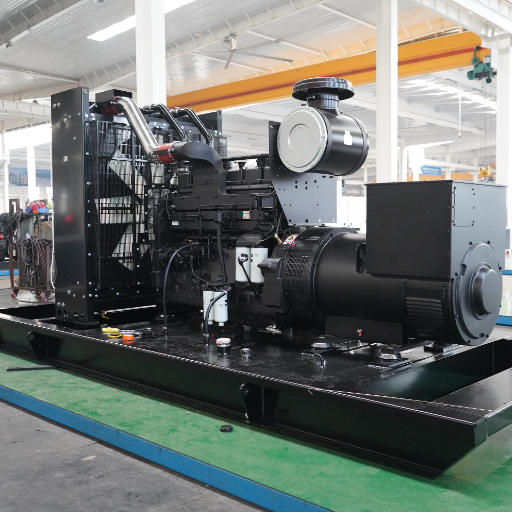
The fan and its drive reward a short inspection at every service, because every fault on this list is cheaper to catch early.
| Check | How | Interval |
|---|---|---|
| Fan orientation | Concave face of the blade is the pressure face | After any rebuild or blade change |
| Blade condition | Cracks at root, bent blades, corrosion, missing guard | Every service |
| Belt wear pattern | Edge wear, glazing, cracking, fraying | Every service |
| Pulley alignment | Straight edge across pulley faces, belt off | At belt replacement |
| Belt tension | Per the engine manual | Every service |
| Bearing condition | Spin by hand, listen for roughness, check lateral play | Every service |
| Airflow | Core clear of debris, air reaching the core | Every service |
One note on the last row. The fan can be perfect and the airflow still be blocked. Debris, insects and dust in the core fins stop air whether the fan is turning or not, and that is the single most common cause of an overheating radiator.
The fan shroud deserves a line of its own here. It looks like a guard, but its job is aerodynamic: it stops air from spilling around the blade tips instead of passing through the core. A shroud that is missing, cracked or sitting too far from the blade can cost a noticeable share of the fan’s airflow while the fan itself tests perfectly. Our generator radiator page covers cleaning and how to tell an external blockage from an internal one.
Where the fan stops and the room starts
A generator cooling fan moves air through the radiator. It does not ventilate the room. Those are two different systems with two different failure modes, and confusing them sends people looking for a fan fault when the real problem is a louver or a duct.
If the set is in an enclosure or a plant room, the hot air the fan discharges has to go somewhere. When it cannot leave, the room heats up, the air entering the radiator gets hotter, and cooling capacity falls even though the fan is doing its job. Our guide to generator room ventilation covers the CFM calculation and the static pressure limits that decide whether the room is the problem.
On an air-cooled set the arrangement is different again. There is no radiator and no coolant. An engine-driven fan blows air directly across finned cylinders and heads, so the fan is the entire cooling system rather than one part of it. Our comparison of air-cooled and liquid-cooled generators explains where that line falls.
When the fan is somewhere else
On a remote-radiator installation the fan is not on the engine at all. It sits with the radiator, wherever that has been placed, and it usually runs on an electric motor.
That changes two things. The fan speed is set by the motor and its control rather than by engine speed, and the fan’s power now comes off the generator it is cooling. On a standby set, NFPA 110 requires the cooling fan to run on the emergency power source, so that load has to be in the capacity calculation. Our guide to the remote radiator generator covers the design limits.
Conclusion
A generator cooling fan is a simple part in a system where simple failures have expensive consequences. The checks that matter are short and physical, and most of them need nothing more than a torch and a straight edge.
- Confirm the fan type and orientation. The concave face is the pressure face. A reversed fan still turns and still undercools.
- Read the belt for alignment, not just tension. Edge wear means the pulleys are out of line, and a new belt will wear the same way.
- Replace bent or cracked blades. Straightening does not restore balance, and imbalance loads the bearing and the water pump.
- Spin the fan by hand at every service. Roughness and lateral play are the warning you get before a seizure.
- Separate fan faults from airflow and room faults. A clear core, an intact shroud and a ventilated room matter as much as a turning generator cooling fan.
Shandong Huali has built diesel generator sets since 1999, and our engineering team specifies cooling packages against the ambient conditions and duty cycle each set actually sees. If you are chasing a temperature fault that only appears under load, send us the set details and the symptoms. Contact our engineers →
